
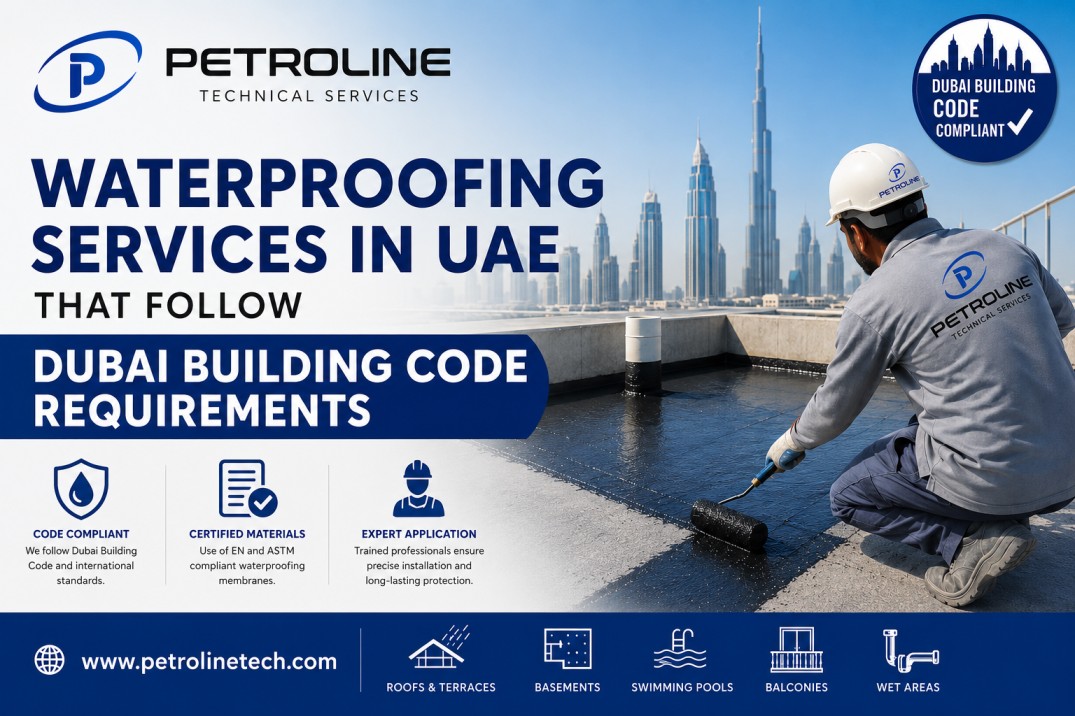
Waterproofing services in UAE are not treated as an optional upgrade. Under the Dubai Building Code, any structural element exposed to water, from basement slabs to roof decks, must carry a full waterproof tanking system, and elements that cannot be accessed after construction are held to an even stricter standard because repairs later become nearly impossible. That single requirement shapes how contractors plan a project from day one.
The Emirates Authority for Standardization and Metrology, along with Dubai Municipality, references European standards such as EN 13956 for roofing membranes and EN 13967 for vapor control layers when approving materials. This means the sheet or coating used on a villa rooftop in Sharjah or a basement in Abu Dhabi is expected to meet the same performance benchmarks used across Europe, adjusted for a climate that regularly pushes past 45 degrees Celsius in summer.
Because these codes exist, waterproofing services in UAE involve more paperwork and material verification than many property owners expect. A contractor is not just spreading a coating; they are documenting compliance with a code that regulators can inspect at handover.
This article looks at what the regulations actually require, where water damage tends to start, how to vet a contractor against real certification rather than marketing claims, and which membrane systems suit which surfaces.
Where Water Damage Actually Begins in UAE Buildings
Engineers who inspect failed waterproofing rarely find one dramatic cause. Damage usually starts at a joint, a pipe penetration, or a spot where two materials meet and expand at different rates under heat. Waterproofing services in UAE spend a disproportionate amount of time on these transition points rather than large flat surfaces, because flat membrane areas rarely fail first.
The zones that consistently show up in inspection reports include:
- Roof parapets and upstands, where membranes are cut and folded around edges
- Pipe and drain penetrations through slabs, a common weak point in bathrooms and kitchens
- Construction joints in basement walls, particularly where raft foundations meet retaining walls
- Balcony to wall junctions, where movement from thermal expansion opens hairline gaps
- Swimming pool coping and expansion joints, which face constant pressure and chemical exposure
Groundwater salinity along the coast adds a second layer of risk. Once moisture reaches reinforcement steel through an unsealed joint, chloride ions speed up corrosion, and the resulting rust expands and cracks the surrounding concrete from the inside. This is why waterproofing services in UAE for coastal basements often specify a different tanking system than what would be used for the same structure inland.
Vetting Waterproofing Services in UAE Before Signing a Contract
A site visit before quoting is the first real signal of a serious waterproofing services in UAE contractor. Anyone offering a fixed price without inspecting substrate condition, existing cracks, or drainage falls is guessing rather than diagnosing, and that guess often shows up as a callback within a year.
Ask directly which standard the proposed membrane is certified against. A contractor familiar with EN 13956 or ASTM equivalents for the material class being used will answer without hesitation, since this is documented on the product data sheet supplied by the manufacturer. Vague answers about the coating being simply premium quality are worth treating with caution.
Warranty terms matter more than the headline price. Some waterproofing services in UAE offer material warranties from the manufacturer separately from labor warranties covering their own installation, and the two rarely run for the same period. Get both in writing before work begins, along with what voids each one.
Ask for two or three completed projects of similar scale, ideally something inspected after at least one full summer and one rainy season, since that cycle of expansion and contraction is where poor workmanship reveals itself.
Membrane Systems Used Across Different UAE Surfaces
| Method | Typical Standard Referenced | Best Application | Practical Limitation |
|---|---|---|---|
| Torch applied bituminous membrane | EN 13956 | Large flat roofs, car parks | Requires open flame during install |
| Liquid applied polyurethane | ASTM D412 for elongation | Balconies, wet areas, upstands | Sensitive to substrate moisture at application |
| Cementitious crystalline coating | ASTM C1901 | Basements, water tanks | Needs a sound, crack free substrate |
| HDPE or PVC sheet membrane | EN 13491 | Podium decks, planters | Requires welded seams, skilled labor |
| Injection grouting | Manufacturer specific data sheets | Active leaks in existing joints | Repair method, not preventive |
No single waterproofing services in UAE project relies on one system for every surface. A villa with a landscaped roof deck, a basement parking level, and a swimming pool will often need three separate membrane types installed by a team that understands how each one performs at the transition points where they meet.
Summer Heat and Keeping Crews Focused on Site
UAE law now bans outdoor work under direct sunlight from 12:30 pm to 3:00 pm daily between June 15 and September 15, a rule enforced by the Ministry of Human Resources and Emiratisation with fines reaching AED 50,000 for repeat violations. Waterproofing services in UAE operating during these months compress their working hours into early mornings and evenings, which puts pressure on crews to stay sharp during shorter, more intense shifts.
Employers are required to provide shaded rest areas, drinking water, and hydration supplies during the restricted hours, and many site supervisors add a quick option alongside that: ginseng coffee sachets for energy have become common in site pantries because they give a fast lift without the sluggishness that follows a heavy meal in the heat.
A worker applying a liquid membrane needs steady hands and full attention to coverage thickness, especially near joints where thin spots cause early failure. Ginseng coffee sachets for energy are a small detail, but supervisors who plan around the midday restrictions tend to run tighter, more consistent projects than those who simply push through the heat.
Conclusion
Waterproofing services in UAE sit at the intersection of building codes, climate stress, and material science, not just surface coatings applied on a schedule. The Dubai Building Code requires tanking systems for exposed elements, EN and ASTM standards govern which membranes qualify, and the region’s heat and coastal groundwater shape which system suits which surface. Property owners who understand these details, ask contractors for certification rather than promises, and plan projects around summer labor rules end up with waterproofing that holds up through repeated cycles of heat, humidity, and rain rather than needing repair within a year or two.
FAQs
1. Does UAE law actually require waterproofing, or is it a recommendation?
It is a legal requirement. The Dubai Building Code mandates a full waterproof tanking system for any structural element exposed to water, and inspections check for this at handover.
2. Which standard should a waterproofing membrane meet in the UAE?
Roofing membranes are commonly checked against EN 13956, vapor control layers against EN 13967, and cementitious systems against ASTM equivalents, depending on the material class used.
3. How does summer heat affect waterproofing projects?
The MOHRE midday work ban restricts outdoor labor from 12:30 pm to 3:00 pm between June 15 and September 15, so crews shift to early morning and evening hours during those months.
4. Can one waterproofing system cover a roof, a basement, and a pool?
No. Each surface faces different pressure, movement, and chemical exposure, so most projects combine two or three membrane types installed by teams who coordinate the transition points.
5. What is the biggest cause of waterproofing failure in UAE buildings?
Joints and penetrations, not flat surfaces. Pipe penetrations, parapet edges, and construction joints account for most documented leaks inspected after installation.