
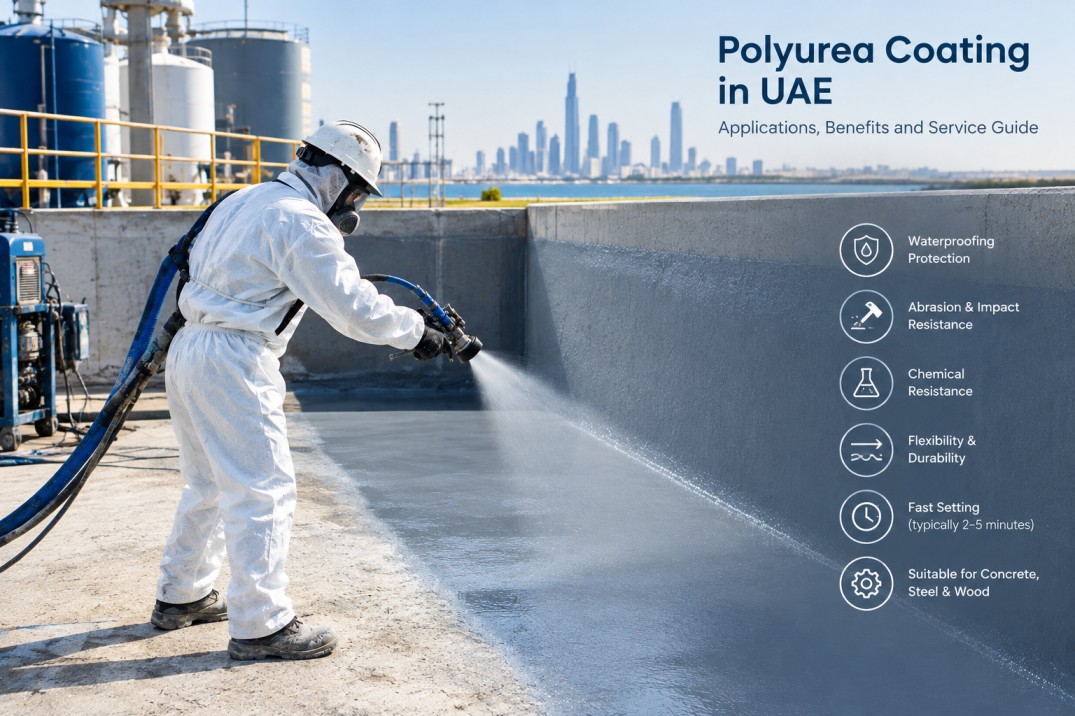
A protective coating is only as reliable as the system selected for the substrate, exposure conditions and expected service. Polyurea is a spray-applied coating technology used to protect concrete, steel and wood from water, abrasion, impact, corrosion and selected chemical exposures. For UAE projects, the right specification and surface preparation are as important as the coating itself.
What Is Polyurea Coating?
Polyurea is a fast-reacting elastomeric coating formed when two components are mixed and sprayed through specialist equipment. It can create a seamless membrane over correctly prepared surfaces, including complex shapes, joints and transitions. Depending on the formulation and project design, the system can be selected for waterproofing, protective lining, impact resistance or wear protection.
A major practical feature is rapid setting. Petroline states that its formulations typically cure in approximately 2 to 5 minutes, although actual return-to-service timing depends on the product, thickness, temperature, substrate, ventilation and inspection requirements. [file:1] Fast curing can reduce disruption, but it also means the application team must control equipment, mixing, overlap and spray technique carefully.
Why Polyurea Suits UAE Projects
UAE assets may be exposed to intense sunlight, heat, dust, humidity, salt-laden air, mechanical traffic and thermal movement. Polyurea can be useful in these settings because properly specified systems offer flexibility, abrasion resistance, chemical resistance and strong adhesion to prepared substrates. It is not a universal solution: compatibility, moisture, surface profile, primer selection, thickness and environmental conditions must be assessed before work begins.
For a commercial or industrial site, the key question is not simply whether polyurea is durable. It is whether the complete coating system suits the substrate, expected exposure, and required service life. A competent contractor should explain that system rather than selling a coating as a one-product fix.
Where Polyurea Coating Is Used
Concrete, steel and wood
Polyurea coating in UAE protects prepared concrete, steel and wood surfaces from moisture ingress, abrasion and environmental deterioration. Concrete may require crack repair, cleaning, profiling and moisture assessment. Steel generally needs preparation to remove corrosion, mill scale, oil and contamination. Wood must be sound, dry and stable enough to receive the specified system.
Floors and industrial areas
Industrial floors, warehouses, workshops, production areas and loading zones can require resistance to traffic, impact, oils, chemicals and repeated cleaning. Polyurea may be considered where a seamless, resilient lining and short interruption period are valuable. The design should still account for drainage, slip resistance, joint details, traffic type and required thickness.
Tanks, canals and water-related assets
Polyurea is used for protective lining and waterproofing applications involving tanks, pipes, canals, pools and water channels. The exact formulation must match the fluid, temperature, immersion conditions and any regulatory or potable-water requirements. Do not assume that every polyurea product is suitable for drinking-water contact or continuous immersion.
Marine and infrastructure applications
Marine vessels, bridges, tunnels and other infrastructure may benefit from a flexible protective layer that helps resist water, abrasion and environmental wear. Petroline lists boats, canals, water channels, bridges and tunnels among its application examples. [file:1] Project specifications should define access, repairs, movement, impact, chemical exposure and inspection requirements before application.
Key Benefits and Practical Limitations
| Potential benefit | What it means in practice |
| Rapid setting | Can support faster project turnover when the substrate and application conditions are ready. |
| Seamless coverage | Reduces reliance on sheet joints, provided detailing and spray continuity are properly controlled. |
| Flexibility | Can accommodate some movement better than rigid coatings; the system still needs correct joint and crack treatment. |
| Abrasion resistance | Useful for selected floors, channels, decks and high-wear surfaces when thickness and formulation are correctly specified. |
| Chemical resistance | Performance depends on the specific chemical, concentration, temperature, exposure duration and product data. |
| Preparation sensitivity | Poor cleaning, moisture, weak concrete or unsuitable priming can compromise adhesion and durability. |
| Specialist application | Plural-component equipment, trained applicators and inspection controls are essential for consistent results. |
The most common mistake is treating fast curing as a substitute for preparation. Polyurea may set quickly, but it cannot correct laitance, oil contamination, active water, weak concrete or poorly designed details beneath the coating.
How the Application Process Works
Assessment and specification
The contractor should first identify the substrate, current condition, dimensions, access, exposure, expected traffic, liquid or chemical contact and required finish. This information guides formulation, primer, thickness, reinforcement, termination details and testing requirements.
Surface preparation
Preparation commonly includes cleaning, removal of unsound material, mechanical profiling, crack and joint treatment, repairs and priming where required. The acceptable surface condition depends on the substrate and specified system. Moisture and environmental conditions should be checked before spraying.
Spray application
Specialist equipment heats, meters and mixes the components before spraying. The applicator controls pass speed, overlap, thickness and detailing around penetrations, corners, drains and terminations. A mock-up or test area can help confirm appearance, adhesion and application settings before full production.
Inspection and handover
Quality control may include visual inspection, thickness checks, adhesion testing, holiday or pinhole detection where applicable, and documentation of repairs and environmental readings. The handover should identify the product system, areas treated, limitations, curing or protection requirements and maintenance guidance.
How to Choose a Polyurea Coating Service in UAE
When comparing providers, focus on the complete system and execution plan rather than price per square metre alone. Ask the contractor to explain:
- Which formulation and primer are proposed for the substrate and exposure.
- How cracks, joints, penetrations, edges and drains will be detailed.
- What preparation method and moisture limits apply.
- How thickness, adhesion and defects will be inspected.
- How the site will be protected from dust, traffic, humidity and contamination.
- What documentation, warranty conditions and maintenance instructions will be provided.
- Whether the team can mobilise to the relevant UAE Emirate and coordinate with site operations.
Petroline Technical Services states that it serves Abu Dhabi, Dubai, Sharjah, Fujairah, Ras Al Khaimah, Ajman and Umm Al Quwain, and lists assessment, preparation, spray application and quality control within its process. Confirm the scope, specification and inspection plan for your individual project before appointment.
For polyurea coating in UAE projects, a site survey is the sensible starting point. Share drawings or measurements, substrate type, existing damage, exposure conditions, access restrictions and the intended use of the area so the proposed system can be assessed accurately.
FAQs
1. What is polyurea coating used for?
It is used as a protective or waterproofing layer for prepared concrete, steel and wood, including industrial floors, tanks, canals, pools, marine assets, bridges and tunnels.
2. How quickly does polyurea cure?
Petroline states that its formulations typically set in about 2 to 5 minutes. Actual return-to-service timing depends on the formulation, thickness, substrate, environment and inspection requirements.
3. Can polyurea be applied to concrete, steel and wood?
Yes, but each substrate requires suitable preparation and, where specified, a compatible primer. The surface must be sound, clean and suitable for the proposed system.
4. Is polyurea suitable for UAE heat and humidity?
Some systems are designed for demanding temperature and humidity conditions, but suitability must be confirmed from the product data and site assessment. Heat, moisture, contamination and substrate condition still affect application quality.
5. Is polyurea suitable for water tanks?
It can be used for selected tank and water-related lining projects. The formulation must be approved for the intended fluid, immersion conditions, temperature and any potable-water requirements.