
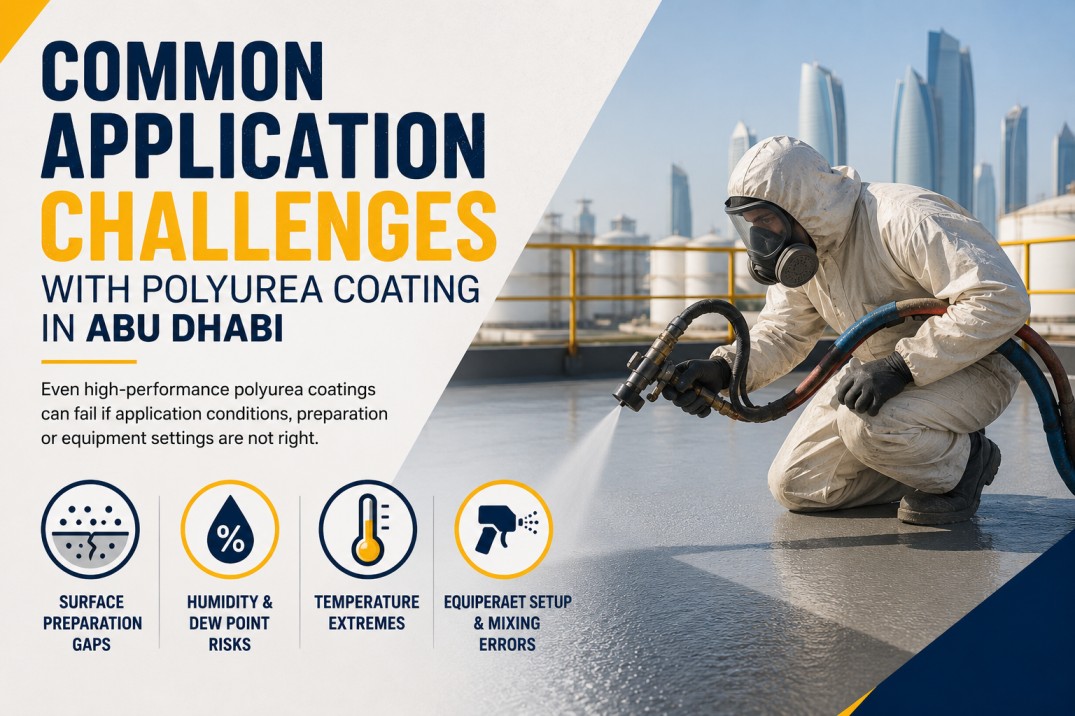
Polyurea coatings deliver exceptional durability, chemical resistance, and rapid cure times for industrial and commercial assets. However, in Abu Dhabi’s extreme climate, even high-performance systems can fail if application conditions, surface preparation, or equipment settings are off. This article outlines the most common application challenges with polyurea coating in Abu Dhabi and how to avoid them.
1. Surface Preparation Gaps
Industry data consistently shows that 70–80% of coating failures originate in surface preparation. For polyurea coating in Abu Dhabi, dense, power-troweled concrete slabs and steel with mill scale demand aggressive profiling to achieve adhesion.
- Concrete: Remove laitance, curing compounds, and contaminants; achieve ICRI CSP 3–5 via shot blasting or grinding.
- Steel: Blast to SSPC-SP 10/NACE 2 (near-white metal) with a defined anchor pattern; remove rust, oil, and old coatings.
- Moisture: Confirm concrete moisture ≤ 3 lbs/1,000 sq ft/24h (CaCl₂) or ≤ 80% RH (in-situ probe). If exceeded, apply a moisture-tolerant epoxy primer or vapor barrier before polyurea.
In Abu Dhabi, form release agents, silane sealers, and dust from nearby construction often contaminate substrates. Skipping solvent wipes, abrasive media checks, or moisture testing is a frequent root cause of delamination in polyurea coating in Abu Dhabi projects.
2. Humidity, Dew Point, and Condensation Risks
Abu Dhabi’s coastal humidity can swing from near-zero inland to near-saturation along the shoreline. While polyurea cures rapidly and is less sensitive to humidity than moisture-cured urethanes, applying too close to the dew point still causes blistering and adhesion loss.
- Rule of thumb: Substrate temperature must be at least 3–5 °C (5–9 °F) above the dew point.
- Relative humidity: Keep below 85% during application; avoid spraying in rain, fog, or when condensation is active.
- Surface moisture: For concrete, keep moisture content below 4–8% depending on the system; verify with Tramex or similar meters.
Field reports from Gulf projects note blistering when polyurea is applied over substrates within 3 °C of dew point, even with fast-cure formulations. For polyurea coating in Abu Dhabi, scheduling early-morning or late-evening passes without dew-point checks is a common but avoidable error.
3. Temperature Extremes and Substrate Heat
Ambient temperatures in Abu Dhabi regularly exceed 45–50 °C in summer. High substrate heat accelerates gel times, reduces working time, and can lead to uneven film build, orange peel, or pinholing.
- Typical application window: 10–45 °C ambient and substrate; material temperatures per manufacturer spec (often 20–35 °C).
- Mitigation: Shade substrates, pre-cool materials, and adjust spray parameters (pressure, ratio, fan pattern) for hot conditions.
- Avoid direct noon sun on dark substrates; surface temperatures can exceed ambient by 10–15 °C.
In practice, teams applying polyurea coating in Abu Dhabi on sun-exposed tanks or decks report better outcomes when they monitor substrate temperature continuously and pause when it spikes beyond spec. Rushing passes to beat heat often creates thin spots and weak bonds.
4. Equipment Setup and Mixing Errors
Polyurea is a plural-component system requiring precise 1:1 (or specified) ratio, correct pressure balance, and thorough impingement mixing. Small deviations cause incomplete cure, tackiness, brittleness, or soft spots.
- Calibrate proportioners before each shift; verify A/B side pressures and temperatures.
- Use manufacturer-recommended tips, hoses, and heaters; maintain hose temperatures to prevent viscosity shifts.
- Perform spray-out tests on cardboard or test panels to confirm gel time, pattern, and mix quality before production runs.
On large Abu Dhabi projects, equipment left in the sun without temperature control can drift out of spec mid-day. For polyurea coating in Abu Dhabi, a simple pre-shift checklist—pressure balance, filter checks, hose heat, and test sprays—prevents most mixing-related failures.
5. Film Thickness, Coverage, and Edge Detailing
Under-application leaves thin films that abrade quickly; over-application can cause exotherm, shrinkage, and cracking. Edges, corners, and transitions are especially vulnerable when not detailed correctly.
- Target DFT: Follow the system data sheet (commonly 1.5–3.0 mm for waterproofing/containment; 0.5–1.5 mm for flooring).
- Measure wet and dry film thickness at multiple points; adjust pass speed and overlap accordingly.
- Detailing: Pre-fill sharp corners, use reinforcing fabric at cracks/joints, and feather edges to prevent lifting.
In tank linings and secondary containment, missed corners or insufficient thickness at weld seams are recurring defects. For polyurea coating in Abu Dhabi, specifying QA checkpoints for DFT and edge detailing reduces rework and extends service life.
6. Contamination and Environmental Controls
Dust, oil, salt spray, and wind-blown sand can settle on freshly sprayed polyurea before it gels, creating inclusions and weak spots. Abu Dhabi’s industrial zones and coastal sites amplify this risk.
- Wind: Avoid spraying in strong winds; use temporary windbreaks around open decks and tanks.
- Dust control: Dampen adjacent areas (without wetting the substrate), schedule around nearby blasting or grinding.
- Salt and oil: Wipe down substrates immediately before spraying; re-clean if delays occur.
Projects that skip environmental monitoring often see pinholes and rough texture in polyurea coating in Abu Dhabi applications, especially on vertical surfaces and overhangs. A simple site log for wind, dust events, and cleaning times helps trace and prevent defects.
7. Curing Misconceptions and Early Traffic
Polyurea gels in seconds and reaches handling strength quickly, but full chemical resistance and adhesion develop over hours. Allowing early traffic, water immersion, or chemical exposure before full cure can damage the film.
- Typical cure: Tack-free in seconds to minutes; full cure in 4–24 hours depending on thickness and temperature.
- Restrict foot traffic for at least 4–6 hours; vehicle traffic and immersion per manufacturer guidance (often 12–24 hours).
- Hot substrates accelerate surface cure but may trap solvents or moisture in thick sections; follow system-specific cure schedules.
In fast-track Abu Dhabi projects, teams sometimes open floors to traffic the same day. For polyurea coating in Abu Dhabi, coordinating cure times with project schedules prevents premature wear and adhesion issues.
How Petroline Technical Services Reduces Application Risks
Petroline Technical Services delivers polyurea coating in Abu Dhabi with strict QA/QC protocols, trained applicators, and modern plural-component equipment. Our approach addresses the challenges above through:
- Documented surface preparation to ICRI/SSPC standards with moisture and dew-point verification.
- Environmental monitoring (temperature, humidity, dew point, wind) logged per shift.
- Equipment calibration, test sprays, and DFT checks at defined intervals.
- Detailed edge and joint treatment, including reinforcing fabrics where required.
- Clear cure-time handover plans to avoid early traffic or immersion.
Clients seeking reliable polyurea coating in Abu Dhabi benefit from reduced rework, longer asset life, and predictable project timelines.
FAQs
1. What are the most common causes of polyurea coating failure in Abu Dhabi?
The top causes are inadequate surface preparation, applying too close to the dew point, high substrate temperatures, incorrect equipment ratios/pressures, and contamination from dust, oil, or salt. These issues lead to delamination, blistering, pinholing, and uneven cure in polyurea coating in Abu Dhabi projects.
2. How does Abu Dhabi’s climate affect polyurea application?
High ambient and substrate temperatures accelerate gel times and can cause orange peel or pinholing. Coastal humidity increases dew-point risks, leading to blistering if the substrate is within 3–5 °C of dew point. Proper shading, timing, and environmental controls are essential for polyurea coating in Abu Dhabi.
3. What surface moisture level is acceptable before applying polyurea?
For concrete, typical limits are ≤ 3 lbs/1,000 sq ft/24h (calcium chloride test) or ≤ 80% RH (in-situ probe). Some systems require surface moisture below 4–8%. If moisture exceeds these thresholds, a moisture-tolerant epoxy primer or vapor barrier should be used before polyurea coating in Abu Dhabi.
4. How quickly can polyurea be put into service after application?
Polyurea is tack-free within seconds to minutes and can handle light foot traffic in 4–6 hours. Full chemical resistance and immersion service usually require 12–24 hours, depending on film thickness and temperature. Always follow the specific system’s cure schedule for polyurea coating in Abu Dhabi.
5. Can polyurea be applied in high humidity or on damp surfaces?
Polyurea cures rapidly and tolerates higher humidity better than moisture-cured urethanes, but it should not be applied when the substrate is within 3–5 °C of the dew point or when condensation is present. Surface moisture must still be within manufacturer limits to avoid blistering in polyurea coating in Abu Dhabi.