
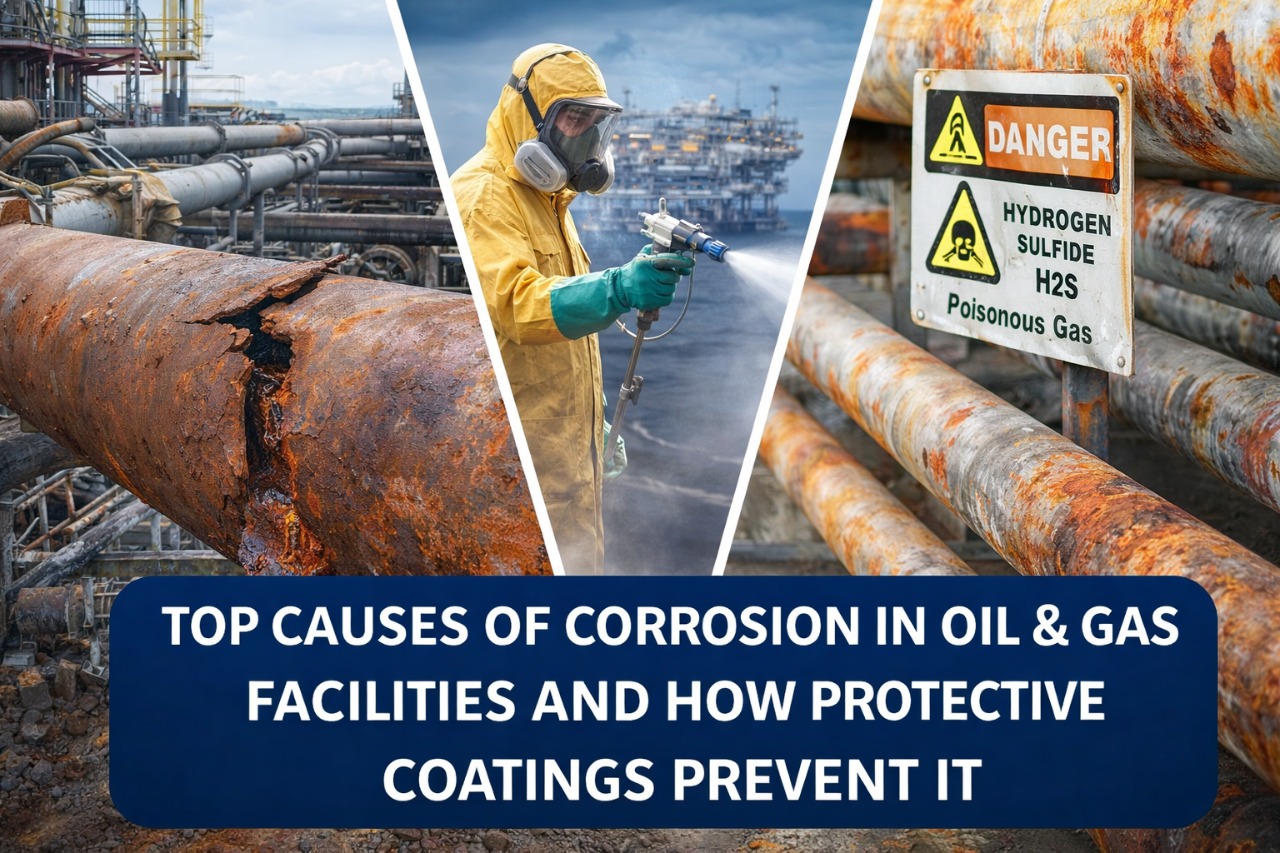
We’ve watched million-dollar equipment fail because operators ignored corrosion until it was too late. Pipelines spring leaks. Platforms develop structural issues. Production stops cold.
The frustrating part? Most corrosion damage is completely preventable.
Why Oil & Gas Facilities Corrode So Fast
Your equipment isn’t just dealing with one corrosion source—it’s getting hammered from multiple directions simultaneously.
Water Does Most of the Damage
Here’s what happens in aging oil fields: water content keeps climbing. Some wells produce 95% water, only 5% oil. That water isn’t sitting idle.
Mix water with other compounds present in oil and gas operations, and you’ve created an electrochemical attack on steel. Offshore rigs get pounded by saltwater constantly. Onshore operations pull up formation water loaded with dissolved minerals.
The water itself wouldn’t be catastrophic. Combined with everything else though? Equipment doesn’t stand a chance without protection.
CO2 Eats Through Steel Surprisingly Fast
Industry folks call it “sweet corrosion.” Sounds harmless. It’s not.
Pure CO2 gas won’t hurt steel. Add moisture and things change dramatically. You’ve now got carbonic acid forming, dissolving iron from pipe walls and equipment surfaces. The reaction leaves behind iron carbonate scale while the metal underneath keeps thinning.
Roughly 60% of equipment failures in oil production trace back to CO2 corrosion. That’s a staggering number.
H2S Makes Everything Worse
When hydrogen sulfide concentrations cross certain levels, you’re in “sour” territory—and the corrosion gets vicious.
H2S mixing with water produces sulfuric acid. Beyond eating away at surfaces generally, it causes stress cracking. Metal becomes brittle. Failures happen without warning. We’ve seen pipelines that looked fine externally but had completely compromised internal structure from H2S exposure.
Way more dangerous than sweet corrosion, both for equipment integrity and worker safety.
Temperature Swings Stress Everything
High heat speeds up chemical reactions attacking your equipment. Metals expand when hot, contract when cool. Do that repeatedly and you’re creating stress beyond what materials can handle long-term.
Deepwater drilling combines high pressure with temperature extremes. Arctic operations deal with cold that turns certain metals brittle. Both scenarios accelerate corrosion through thermal cycling.
Don’t Forget Oxygen and Salt
Oxygen dissolved in drilling muds attacks drill pipe aggressively during operations. Chloride ions—from seawater or formation brines—ramp up corrosion rates dramatically.
Chlorides cause pitting particularly. Small holes that penetrate deep into metal, often causing leaks before you’d expect them from general thinning. Nasty stuff.
Different Corrosion Types Attack Different Ways
Pitting creates localized holes going deep rather than thinning surfaces uniformly. Hard to spot visually until it’s already caused problems.
Crevice corrosion happens where you can’t easily inspect—under gaskets, inside flanges, any tight space where fluid sits stagnant. These spots corrode faster than exposed areas.
Galvanic corrosion occurs when dissimilar metals touch in the presence of water or other electrolytes. One metal corrodes protecting the other. Seen this destroy expensive fittings connected to carbon steel piping.
Erosion-corrosion combines mechanical wear with chemical attack. High-velocity fluids carrying sand literally sandblast away protective layers while corrosion eats the exposed metal underneath.
Microbiologically influenced corrosion involves bacteria accelerating breakdown through their metabolic processes. Common in water-flooded reservoirs and anywhere flow stagnates.
How Coatings Actually Prevent Corrosion
Modern protective coatings create barriers between hostile environments and your valuable equipment. Different coatings serve different protection needs based on conditions.
Epoxy Systems Handle Most Applications
Epoxy dominates oil and gas coating work. Bonds incredibly well to steel. Creates tough barriers against moisture and chemicals.
Fusion-bonded epoxy gets applied as powder at high heat, forming continuous films with excellent adhesion. Protects pipeline interiors and exteriors effectively.
Multi-layer epoxy systems build up thickness for better protection while maintaining some flexibility for thermal expansion and contraction.
Polyurethane Adds Flexibility
Polyurethane handles UV exposure better than epoxy. More flexible too, which matters for equipment experiencing temperature swings or mechanical stress.
That elasticity absorbs impacts without cracking valuable for platforms and structures getting bumped during operations.
Polyurea Sets Incredibly Fast
Polyurea cures in seconds. Literally. You can apply coating and get equipment back in service the same day in many cases.
Extremely abrasion-resistant and chemically tolerant. Creates seamless, completely watertight barriers. Perfect for high-wear zones needing quick turnaround.
Zinc Primers Sacrifice Themselves
Inorganic zinc coatings provide cathodic protection—zinc corrodes instead of steel underneath. Works brilliantly as first coat in multi-layer systems, giving you backup protection if top coats get scratched or damaged.
Thermal Spray for Extreme Heat
When temperatures exceed what polymer coatings handle, thermal spray metallizing becomes necessary. Aluminum or zinc sprayed onto surfaces creates metallic barriers that tolerate extreme heat.
Picking the Right Coating
Temperature ranges your equipment sees determine coating chemistry options. Polymer coatings work to certain limits; beyond that you need thermal spray.
Specific chemicals present dictate which coatings resist attack adequately. H2S requires different solutions than straight CO2 exposure.
Mechanical abuse from fluid erosion, impacts, or abrasion influences whether rigid or flexible coatings perform better long-term.
How you’ll apply it matters practically. Some coatings spray on easily. Others need brush or roller application. Complex shapes might limit your options.
Access for future maintenance affects whether you specify ultra-long-life coatings or accept periodic recoating as planned maintenance.
Application Quality Determines Success
Best coating in the world fails if applied poorly. Surface prep matters more than coating choice.
Steel must be blasted clean—removing rust, mill scale, contaminants—while creating surface profile for mechanical bonding. Shortcuts here guarantee coating failure.
Temperature, humidity, surface temperature during application all affect how coatings cure and perform. Rushing jobs in poor conditions produces garbage results regardless of material quality.
Multi-coat systems need proper timing between coats so layers bond together. Miss the recoat window and you’ve got delamination waiting to happen.
Measure film thickness. Check for holidays (pinholes). Test adhesion. Quality control catches problems before they become expensive failures.
Coatings Work Best With Other Protection
Cathodic protection backs up coatings on buried or underwater structures, protecting where coating damage might occur.
Corrosion inhibitors pumped into process streams protect internal surfaces where applying coatings isn’t practical.
Sometimes upgrading to corrosion-resistant alloys makes more economic sense than coating carbon steel repeatedly.
Monitoring programs—inspections, ultrasonic thickness checks, corrosion probes—catch deterioration early before it becomes critical.
Water management, controlling water cut and treating produced water, reduces how aggressive conditions are overall.
Stop Letting Corrosion Win
Corrosive conditions in oil and gas won’t improve. Water, CO2, H2S, temperature cycling—these keep attacking steel relentlessly.
You decide whether corrosion destroys your assets or just requires periodic coating maintenance. Technology exists to protect equipment properly when correctly applied.
Look honestly at your corrosive environment. Match coatings to those specific conditions. Don’t accept shortcuts on surface prep or application quality. Monitor regularly to catch issues early.
Your facilities cost too much to let corrosion destroy them prematurely.
Need corrosion protection that actually works? Petroline Technical Service has protected oil and gas assets across Abu Dhabi and UAE for years. We understand your corrosive conditions and apply coatings that extend equipment life. Call us for honest assessment and proven solutions.