
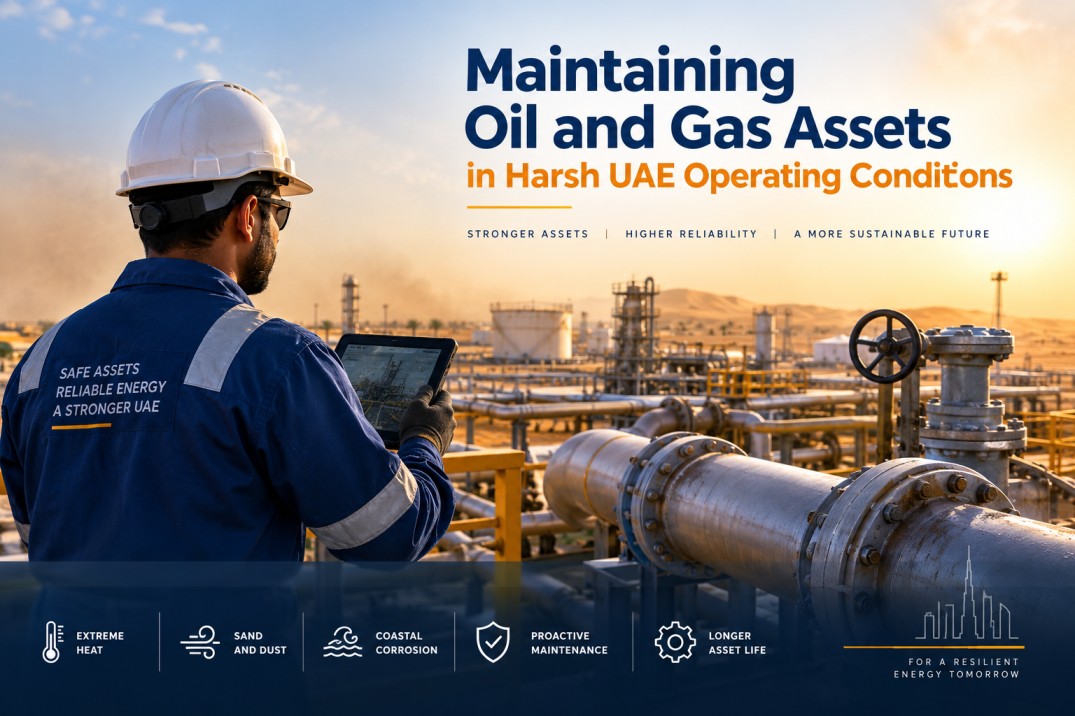
The UAE’s oil and gas sector operates under some of the world’s toughest environmental conditions. Sustained summer temperatures above 45–50°C, frequent sandstorms, high coastal humidity, and corrosive salt spray accelerate wear on pipelines, tanks, separators, compressors, and structural steel. In this context, high-quality oil and gas field services in UAE are not optional; they are essential to asset integrity, safety, and production uptime.
Operators across Abu Dhabi, Dubai, Sharjah, and the Northern Emirates rely on specialized maintenance providers to deliver corrosion protection, surface preparation, protective coatings, and reliability-focused interventions. This article explains how to maintain oil and gas assets in the harsh operating conditions of the UAE, with practical strategies, examples, and data-driven insights to maximize asset life while controlling costs.
Why UAE Conditions Are Uniquely Harsh for Oil and Gas Assets
UAE onshore fields and coastal facilities face a combination of stressors that compound degradation rates:
- Extreme heat: Ambient temperatures regularly reach 48–52°C in summer, driving thermal expansion, lube oil degradation, and equipment derating.
- Sand and dust ingress: Shamal winds and frequent dust storms introduce abrasive particulates that erode coatings, clog filters, and accelerate mechanical wear.
- Coastal corrosion: High humidity and salt spray in offshore and near-shore assets increase corrosion rates on carbon steel and welds.
- Thermal cycling: Day–night temperature swings and process heat cycles cause fatigue in gaskets, flanges, and protective layers.
Industry observations in the region indicate failure rates for heavy equipment can be 20–30% higher than in temperate climates when maintenance is reactive. That is why structured oil and gas field services in UAE focus on prevention, not just repair.
Core Maintenance Challenges in UAE Oil and Gas Fields
Maintenance teams contend with interlinked challenges that demand integrated solutions:
- Corrosion under insulation (CUI) and general corrosion: Salt-laden air and humidity penetrate insulation jackets and coating defects, leading to hidden metal loss on pipes and vessels.
- Coating breakdown and blistering: UV exposure, heat, and surface contamination cause premature coating failure if surface preparation and application are not tightly controlled.
- Sand erosion on exposed surfaces: Wind-blown sand abrades external coatings and instrumentation, especially on elevated structures and piping racks.
- Heat stress on personnel and schedules: Worker heat stress limits safe work windows, compressing maintenance activities and increasing the risk of rework.
- Remote logistics and response time: Desert locations and offshore platforms can be hours from support, making rapid mobilization and robust planning critical.
Addressing these challenges requires a mix of engineering discipline, advanced materials, and field execution excellence—all hallmarks of professional oil and gas field services in UAE.
Best-Practice Maintenance Strategies for Harsh UAE Conditions
Leading operators combine risk-based planning with robust field execution. The following strategies are particularly effective in the UAE environment:
1) Risk-Based Inspection (RBI) and Asset Criticality
Adopt API 580/581-aligned RBI for static assets (piping, vessels, heat exchangers) and run Failure Mode, Effects, and Criticality Analysis (FMECA) to classify assets as High/Medium/Low criticality. Focus 80% of predictive efforts on “bad actors” such as main oil export pumps, production separators, and gas compressors. This prioritization is a core component of effective oil and gas field services in UAE, ensuring resources target the highest-consequence risks first.
2) Precision Surface Preparation and Coating Systems
Coating life in the UAE is highly sensitive to surface preparation. Specify abrasive blasting to Sa 2½ (ISO 8501-1) with defined anchor profiles, followed by high-performance systems such as epoxy primers, polyurethane or polysiloxane topcoats, and polyurea for high-abrasion zones. For tank interiors and aggressive chemical service, consider novolac epoxy or FRP/GRP linings. Properly executed, these systems extend repaint cycles and reduce total cost of ownership—a key outcome of quality oil and gas field services in UAE.
3) Corrosion Protection and Cathodic Systems
Combine barrier coatings with cathodic protection (CP) for buried and submerged assets. Regular CP surveys, holiday detection, and prompt repair of coating defects prevent localized corrosion from escalating. In coastal facilities, CP plus robust coating specs is a standard requirement for oil and gas field services in UAE.
4) Condition Monitoring and Predictive Maintenance
Implement a three-pillar condition monitoring strategy for rotating equipment: vibration analysis, tribology/oil analysis, and airborne ultrasound. Add thermography for electrical assets and process lines. Integrate data into a CMMS (e.g., SAP PM, IBM Maximo) with high-quality work order histories to enable trend analysis and early defect elimination. Predictive maintenance is increasingly embedded in digital oil and gas field services in UAE to cut unplanned downtime.
5) Shutdown Planning and Scope Control
For turnarounds, enforce a scope freeze 12–18 months out, lock long-lead materials early, and pre-fabricate spools and supports offsite to reduce hot work and field hours. In summer, schedule critical tasks in cooler windows and use heat-mitigation measures (shade, cooling vests, hydration protocols). Strong planning is what separates routine maintenance from high-impact oil and gas field services in UAE.
Materials and Technologies That Work in the UAE
Material selection must account for heat, UV, sand, and chlorides. Proven choices include:
- High-solids epoxy and polysiloxane topcoats for UV and heat resistance
- Polyurea elastomers for fast cure, impact resistance, and chemical/abrasion tolerance
- Novolac epoxy and FRP/GRP linings for aggressive chemical and sour service
- Thermal spray aluminum (TSA) or zinc-rich primers for long-term corrosion protection
- Fireproofing and blast-resistant coatings for process areas and control buildings
Digital tools—remote monitoring, AI analytics, and GPS fleet tracking—further enhance reliability by enabling real-time visibility of assets and crews. These capabilities are now expected from advanced oil and gas field services in UAE providers.
Execution Excellence and Safety in Extreme Heat
Even the best specs fail without disciplined execution. Key practices include:
- Strict QA/QC: Verify surface profile, DFT, adhesion, and holiday testing per project ITP.
- Environmental controls: Monitor dew point, temperature, and relative humidity during coating application.
- HSE focus: Enforce heat-stress management (work–rest cycles, hydration, shaded areas) and PPE integrity checks.
- Competence: Use certified inspectors (e.g., NACE/AMPP, FROSIO) and trained applicators.
- Documentation: Maintain as-built records, coating logs, and CMMS histories for future planning.
Safety and quality discipline directly influence asset life. In the UAE, where heat and corrosion amplify risks, these practices define credible oil and gas field services in UAE.
Cost and ROI Perspective: Why Prevention Pays
Unplanned downtime in UAE oilfields is among the highest operational cost drivers. Studies and field data suggest that shifting from reactive to planned, reliability-focused maintenance can significantly reduce failure frequency and maintenance cost per barrel. Investing in corrosion control, precision surface prep, and predictive monitoring typically delivers ROI through:
- Extended repaint and overhaul intervals
- Lower spare-parts consumption and emergency logistics costs
- Reduced production losses from unplanned shutdowns
- Improved safety performance and regulatory compliance
These outcomes are the business case for partnering with experienced providers of oil and gas field services in UAE.
How Petroline Technical Services Supports Asset Integrity
Petroline Technical Services delivers integrated solutions aligned with the strategies above, including:
- Blasting and painting with controlled surface preparation and QA/QC
- Protective coatings (epoxy, polyurea, polysiloxane, novolac) for structures, tanks, and pipelines
- GRP/FRP lining for corrosion-resistant containment and process equipment
- Waterproofing, crack injection, and concrete repair for civil and structural assets
- ESD and industrial flooring systems for facilities and plants
By combining skilled teams, modern equipment, and strict HSE standards, Petroline supports long-term asset performance across the UAE. This integrated approach is what operators expect from leading oil and gas field services in UAE.
FAQs
1. What maintenance practices best protect oil and gas assets in UAE heat and sand?
Prioritize risk-based inspection, high-performance coatings with proper surface prep, cathodic protection for buried/submerged assets, and predictive maintenance (vibration, oil analysis, ultrasound). Schedule critical work in cooler windows and enforce heat-stress controls.
2. How often should coatings be inspected or recoated in UAE coastal facilities?
Inspection intervals typically range from 6–12 months in aggressive coastal zones, with recoating cycles depending on system selection and exposure. High-solids epoxies and polysiloxanes can extend intervals when applied to Sa 2½ surfaces with strict QA/QC.
3. What are the biggest causes of unplanned downtime in UAE oilfields?
Corrosion-related failures, sand/dust ingress that damages rotating equipment, coating breakdown leading to leaks, and heat-related work constraints that compress maintenance windows and increase the risk of rework.
4. Which coating systems perform best for tanks and pipelines in the UAE?
For tanks: novolac epoxy or FRP/GRP linings for chemical/sour service; for external pipelines: epoxy primers with polyurethane/polysiloxane topcoats, or TSA for long-life corrosion protection. Polyurea is effective in high-abrasion zones.
5. How can digital tools improve maintenance outcomes in harsh UAE conditions?
Remote monitoring, AI analytics, and GPS fleet tracking enable real-time asset visibility, faster response to anomalies, better crew dispatch, and data-driven planning, reducing unplanned downtime and improving safety.