
Maintaining structural integrity across heavy industrial facilities, marine infrastructure, chemical plants, and logistics hubs requires robust concrete repair strategies. Substrates subjected to constant mechanical impact, thermal shock, and corrosive chemical exposure inevitably develop micro-cracks, surface spalling, and bug holes. Standard cementitious mortars and acrylic putties routinely fail under these rigorous operational demands. To achieve a permanent, structural-grade restoration, Jotun epoxy filler serves as an elite, high-performance solution designed specifically for challenging rehabilitation environments.
At Petroline Technical Services, we provide advanced coating technologies and specialized concrete remediation materials that ensure maximum asset longevity. This comprehensive engineering overview breaks down the material physics, rheological behavior, and essential field execution protocols that make Jotun epoxy filler the professional choice for heavy-duty crack and spall remediation.
1. The Physics of Concrete Failure: Why Standard Patching Compounds Fail
Concrete possesses exceptional compressive strength but inherently weak tensile and flexural capacities. Under dynamic machinery vibration, heavy forklift traffic, or foundation settlement, stress concentration forces micro-fractures along weak aggregate boundaries. Traditional cementitious repair mortars and conventional acrylic putties fail prematurely in these settings due to two critical physical flaws:
- Evaporative Shrinkage & Debonding: Cementitious compounds rely on water for workability. As hydration completes and free water evaporates, the mortar undergoes volumetric contraction. This shrinkage creates microscopic pathways along the bond line, allowing moisture and aggressive salts to attack the rebar.
- Shear Incompatibility: Conventional patch putties lack the shear modulus required to resist lateral forces at crack interfaces, leading to cracking and joint failure under heavy rolling loads.
Engineering around these physical limitations, Jotun epoxy filler is engineered as a 100% solids, solvent-free, two-pack epoxy paste. Because it contains no volatile solvents or gauging water to bleed off during chemical cross-linking, its cured volume precisely matches its wet applied volume. Zero dimensional change guarantees total mechanical keying and airtight encapsulation across every capillary void and surface imperfection.
FIELD ENGINEERING PRINCIPLE: Solvent-bearing putties shrink by up to 15% to 20% during drying, pulling away from concrete sidewalls and creating internal stress. A 100% solids system like Jotun epoxy filler cures without volume loss, preserving structural continuity throughout the repair zone.
2. High Compressive & Tensile Strength: Outperforming the Concrete Substrate
An effective structural repair compound must equal or exceed the physical strength profile of the surrounding concrete. High-strength industrial concrete typically yields compressive ratings between 30 MPa and 40 MPa. Upon reaching full cure, Jotun epoxy filler delivers mechanical strength profiles that exceed the physical capacity of the host substrate.
- Load Distribution & Structural Integrity: When subjected to intense point loads from heavy equipment or steel-wheeled vehicles, the cured filler matrix transfers stresses uniformly across the joint without crushing or cracking.
- Interfacial Adhesion Mechanics: Adhesive tensile strength exceeds the concrete’s tensile limit, ensuring that standard pull-off adhesion tests result in concrete substrate fracture rather than bond line separation.
- Abrasion & Wear Resistance: The cross-linked polymeric structure provides exceptional resistance against gouging, mechanical abrasion, and heavy impact from operational traffic.
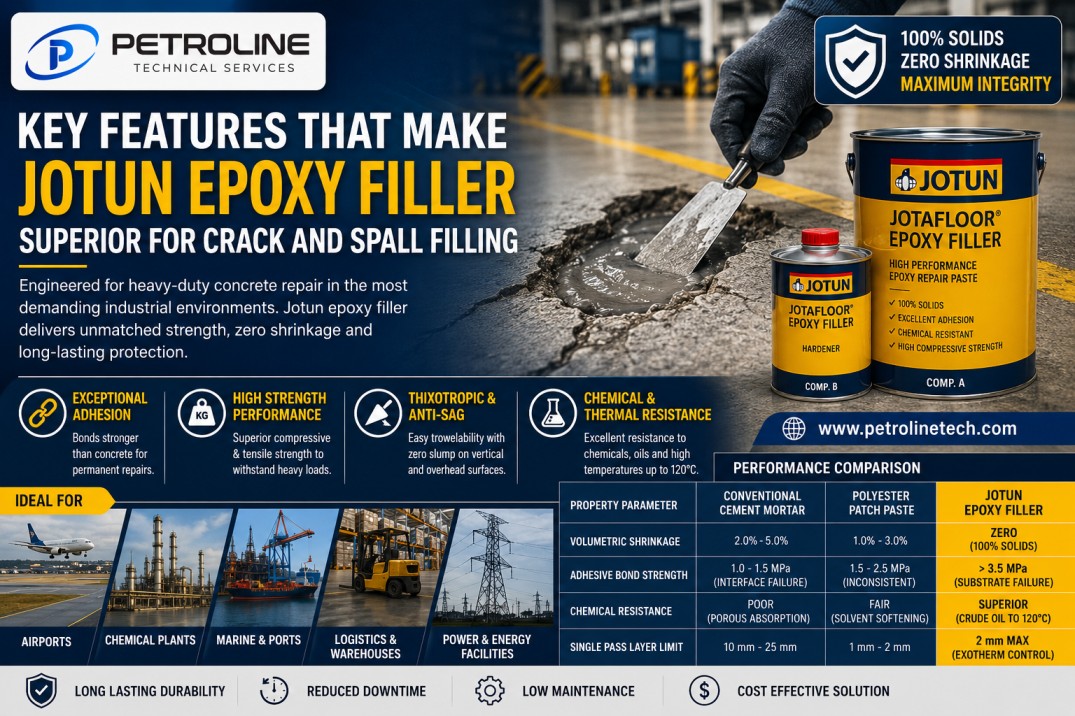
Performance Matrix: Concrete Repair Mortars vs. Jotun Epoxy Filler
| Property Parameter | Conventional Cement Mortar | Polyester Patch Paste | Jotun Epoxy Filler |
| Volumetric Shrinkage | High (2.0% – 5.0%) | Moderate (1.0% – 3.0%) | Zero (100% Solids) |
| Adhesive Bond Strength | 1.0 – 1.5 MPa (Interface Failure) | 1.5 – 2.5 MPa (Inconsistent) | > 3.5 MPa (Substrate Failure) |
| Chemical Resistance | Poor (Porous Absorption) | Fair (Solvent Softening) | Superior (Crude Oil to 120°C) |
| Single Pass Layer Limit | 10 mm – 25 mm | 1 mm – 2 mm | 2 mm max (Exotherm Control) |
3. Rheology & Application Dynamics: Trowelability on Vertical & Overhead Surfaces
A common challenge for applicators restoring vertical piers, overhead soffits, or beam faces is material slump. Unmodified fluid resins flow out of deep spalls before cross-linking can occur. Jotun epoxy filler solves this issue through advanced thixotropic engineering.
When mechanical force is applied—such as pressing the paste into a cavity using a steel trowel or putty blade—the material undergoes shear thinning, lowering its viscosity for smooth workability and capillary penetration. The moment shearing stops, the material instantly reverts to its high static viscosity state. This anti-sag property allows build-ups up to 2,000 microns (2 mm) per pass on vertical and overhead surfaces without slumping or displacement.
Additionally, the surface wetting properties of Jotun epoxy filler ensure deep capillary absorption inside bug holes and honeycombed concrete, forming permanent mechanical roots within the substrate.
4. Thermal & Chemical Resilience in Severe Exposures
Industrial processing zones subject structural foundations to aggressive chemicals and thermal gradients. Jotun epoxy filler is formulated to maintain structural integrity in harsh operating environments where standard materials degrade rapidly.
- Hot Hydrocarbon Immersion: Exhibits outstanding stability when exposed to crude oil and petroleum derivatives at continuous operating temperatures up to 120°C. Storage tanks repaired with this filler can safely resume crude service in 48 hours at 40°C concrete temperatures.
- Chloride & Moisture Impermeability: Creates an impenetrable, non-porous barrier against water ingress, industrial effluents, and airborne chlorides, halting chloride-driven reinforcement bar corrosion.
- Broad Chemical Compatibility: Resists degradation from dilute acids, alkalis, aliphatic solvents, and aggressive washdown detergents used in facility maintenance.
5. Critical Field Execution Parameters (What Technical Datasheets Hide)
While standard product datasheets highlight basic performance metrics, successfully applying Jotun epoxy filler on active job sites requires controlling reaction kinetics and ambient field conditions.
Managing Exotherm Reaction Kinetics & Thickness Thresholds
Epoxy curing is an exothermic chemical process that generates heat as Component A and Component B cross-link. The maximum safe single-pass application depth for Jotun epoxy filler is strictly 2 mm (2,000 microns).
Attempting to fill deep 15 mm cavities in a single application traps heat within the epoxy mass, causing runaway exotherm. This rapid temperature spike leads to internal air gassing, thermal expansion, micro-fissuring, and loss of final bond strength. Deep spalls must be remediated in multiple, staggered 2 mm passes, allowing adequate thermal dissipation between layers.
Pot-Life Adjustments in High-Temperature Climates
The nominal pot life for Jotun epoxy filler is 60 minutes at 23°C. In hot ambient environments such as Dubai and Middle Eastern project sites, ambient surface temperatures often exceed 40°C, compressing the usable pot life down to 15 to 20 minutes.
- Thermal Management: Store unmixed components in shaded or temperature-controlled rooms before batching.
- Batch Volume Reduction: Prepare smaller working sets adhering strictly to the 1.5:1 volume ratio to ensure material is applied well within its open time.
- Mass Heat Dissipation: Transfer mixed epoxy immediately onto flat shallow trays to disperse heat rather than leaving it in deep mixing containers.
Substrate Moisture Content: The 4% Threshold
Concrete surfaces must be verified dry before applying Jotun epoxy filler. Moisture content measured by weight must not exceed 4%. Trapped subsurface moisture subject to solar heating converts into vapor pressure, triggering osmotic blistering and catastrophic debonding over time.
6. Contractor Execution Protocol: Step-by-Step Remediation
To ensure long-term structural repair compliance, site teams at Petroline Technical Services follow this standardized field application procedure when deploying Jotun epoxy filler:
Step 1: Crack Chasing & Structural V-Grooving
Avoid feather-edging over surface cracks. Use a diamond-blade angle grinder to chase all cracks into a clean “V” or “U” profile (minimum 6 mm width and depth). Square off spall perimeter edges to eliminate fragile shoulders.
Step 2: Laitance Removal & Dust Extraction
Mechanically abrade the substrate using shot-blasting or grinding to remove weak surface laitance, oil, greases, and contaminants in accordance with ISO 8504. Execute thorough industrial vacuuming—fine dust particles act as a bond breaker.
Step 3: Precise Proportioning & Mechanical Homogenization
Combine Component A (Base) and Component B (Hardener) at the mandatory 1.5:1 volume ratio. Mix thoroughly using a low-speed drill (300–400 RPM) equipped with a spiral paddle for 3 to 5 minutes until a completely uniform color and streak-free consistency are achieved.
Step 4: Trowel Application & Multi-Pass Layering
Work Jotun epoxy filler firmly into the prepared profile using a flat steel trowel or stiff putty knife, driving out trapped air pockets. Build up deeper repairs in successive 2 mm passes, observing minimum overcoating intervals (24 hours at 23°C or 16 hours at 40°C).
Step 5: Protective Coating System Integration
When cured, Jotun epoxy filler creates a seamless substrate ready for high-performance topcoats, including Jotafloor flooring systems or Penguard intermediate coats. If the maximum recoat window is exceeded, abrade the filler surface to re-establish mechanical profile prior to overcoating.
SITE QA/QC MANDATE: Always monitor environmental dew points. Concrete substrate temperatures must remain at least 3°C above the ambient dew point to avoid micro-condensation during application and curing.
Partner with Petroline Technical Services for Reliable Repair Systems
Restoring concrete infrastructure requires structural materials that provide permanent bond strength, dimensional stability, and resistance to harsh chemicals. By integrating Jotun epoxy filler, asset managers and civil contractors secure long-term protection against continuous mechanical and environmental degradation.
At Petroline Technical Services, we offer genuine protective coating products, technical specification support, and field application expertise tailored to your operational needs. Visit our official platform to discover our complete inventory of surface preparation, protective coating, and concrete rehabilitation products.
7. FAQs
1. What is the exact mixing ratio for Jotun epoxy filler?
Jotun epoxy filler must be mixed at a ratio of 1.5 parts Component A (Base) to 1 part Component B (Curing Agent) by volume. Components must be mechanically blended with a low-speed spiral mixer until complete color homogenization is achieved.
2. What is the maximum single-layer application thickness for Jotun epoxy filler?
The maximum recommended single-pass thickness is 2 mm (2,000 microns). For deeper cavities or spalls, material should be applied in multiple 2 mm layers to avoid exothermic heat accumulation and thermal cracking.
3. How long does Jotun epoxy filler require to achieve full cure?
Curing duration depends on surface temperature. At 23°C, the filler reaches surface dry in 12 hours, through dry in 18 hours, and full cure in 7 days. At 40°C, full cure occurs in 3 days, enabling crude oil tank return-to-service in 48 hours.
4. Can Jotun epoxy filler be applied on overhead concrete beams?
Yes. Formulated with thixotropic modifiers, Jotun epoxy filler resists slumping and sag on vertical and overhead surfaces when applied up to 2 mm per pass using standard troweling tools.
5. Which topcoats can be applied over Jotun epoxy filler?
Jotun epoxy filler provides excellent system compatibility with industrial coating systems, including Jotafloor SF Primer and floor finishes, as well as Penguard protective intermediate coats for steel and concrete assets.