
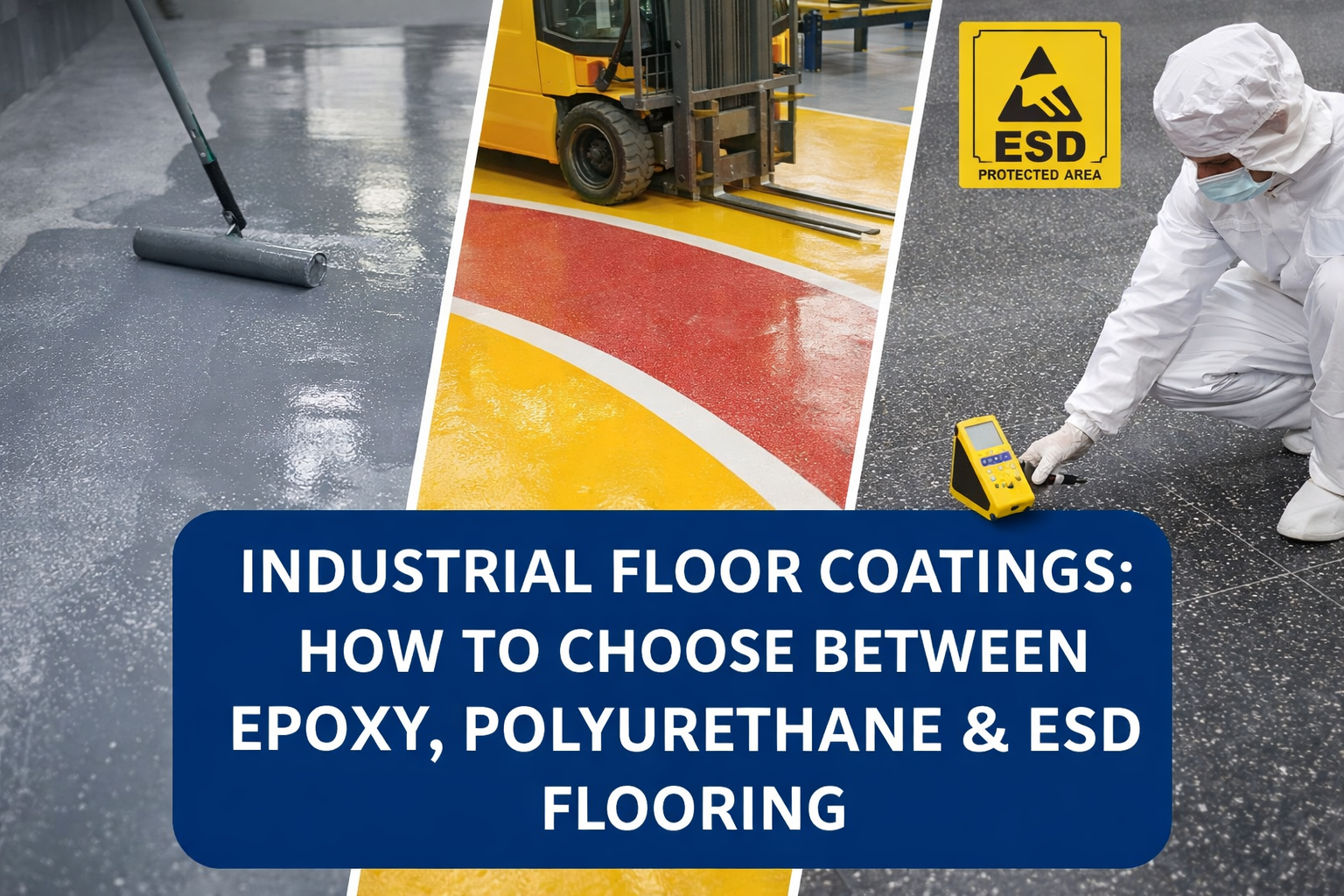
Running a factory or warehouse means dealing with floors that take constant punishment. We’ve seen facilities waste money on the wrong coating—only to redo everything within a couple years.
Here’s what actually works when you’re choosing between epoxy, polyurethane, and ESD flooring.
Why Epoxy Remains Popular in UAE Warehouses
Walk into most Abu Dhabi warehouses and you’ll find epoxy floors. There’s good reason for that.
Mix the two-part system, spread it on concrete, and you get a surface harder than the concrete underneath. Forklifts? No problem. Chemical spills from machinery? Epoxy handles it without staining.
We’re talking about a coating that costs significantly less than alternatives while delivering serious durability. Maintenance is straightforward—regular mopping keeps it looking decent for years.
The color options let you mark traffic lanes, create safety zones, or just make the space look more professional than bare concrete.
Now, before you rush to install epoxy everywhere, know this: direct sunlight turns it yellow. Seen it happen in facilities with skylights. Not pretty. The rigid surface also means scratches show up more than they would on flexible coatings.
Epoxy works brilliantly in covered warehouses, manufacturing areas, and automotive bays where UV exposure isn’t an issue.
When Polyurethane Makes More Sense
Polyurethane costs more upfront. But sometimes it’s worth every dirham.
Unlike epoxy’s rigidity, polyurethane bends. That matters more than you’d think. Heavy impacts that crack epoxy just bounce off polyurethane. Temperature changes that stress rigid coatings? Polyurethane flexes right through them.
Food processing facilities almost always choose polyurethane. Why? It resists the organic acids that destroy other floor coatings. We’ve seen dairy plants where nothing else would last.
Cold storage is another area where polyurethane dominates. Temperatures dropping to -30°C would make rigid coatings brittle and crack. Polyurethane stays flexible.
And that UV resistance we mentioned? Park a polyurethane floor in direct sunlight for five years—still looks the same. Can’t say that about epoxy.
Installation requires more expertise though. Humidity levels during application matter. The coating goes on thinner, so underlying concrete imperfections show through more.
Pharmaceutical plants, parking garages, and any space with windows or outdoor exposure—these benefit from polyurethane’s extra capabilities.
Smart Facilities Use Both
We recommend hybrid systems for many clients. Start with epoxy primer and base coats for strong adhesion and thickness. Finish with polyurethane on top for protection.
You’re essentially building layers—foundation strength from epoxy, weather resistance from polyurethane. Costs more than straight epoxy but less than full polyurethane throughout.
Performance-wise? Better than either coating alone. Seen these systems still performing after 15+ years in high-traffic facilities.
ESD Flooring Isn’t Optional for Electronics
Manufacturing circuit boards or handling sensitive components? Static electricity will destroy your products.
One small zap—imperceptible to humans—ruins components worth thousands. ESD flooring stops that from happening.
The technology incorporates conductive particles (carbon, graphite) throughout the coating. Copper grounding strips underneath connect everything to building ground. Static electricity flows harmlessly away instead of building up.
Both epoxy and polyurethane come in ESD versions. Pick based on your other requirements (temperature, chemicals, UV exposure), then specify the ESD variant.
Testing after installation confirms surface resistance falls between 25,000 and 1,000,000 ohms. Documentation proves you meet ANSI/ESD S20.20 standards—insurance and clients often require this.
Data centers, semiconductor fabs, aerospace manufacturing—anywhere electronics are present, ESD protection prevents expensive losses.
Matching Floors to Your Actual Needs
Forget marketing claims. Look at your facility’s real conditions.
Heavy machinery constantly moving around? Epoxy’s compressive strength makes sense. Mostly people walking? Consider polyurethane or hybrids.
List every chemical that might hit your floor. Some love epoxy; others need polyurethane’s broader resistance.
Temperature swings or refrigeration? Polyurethane’s flexibility prevents cracking that rigid coatings suffer.
Windows, skylights, or outdoor areas? UV resistance means polyurethane or you’ll be looking at yellowed floors.
Working with electronics, even occasionally? ESD protection pays for itself by preventing just one major component failure.
Budget matters, obviously. Calculate 10-year costs though, not just installation. Polyurethane’s longer lifespan often makes it cheaper over time despite higher initial pricing.
Installation Quality Determines Everything
Specifying the right coating is only half the battle. Poor installation ruins even the best materials.
Concrete preparation matters enormously. Surface must be properly profiled, completely dry, contamination-free. Moisture issues cause delamination later—expensive to fix.
Application technique affects adhesion, appearance, longevity. Environmental conditions during installation (temperature, humidity, airborne dust) all impact results.
Finding experienced contractors in Abu Dhabi means checking references from similar facilities. Verify they’ve successfully installed your specific coating type. Ask about warranties covering both materials and workmanship.
Cheap installation that fails early costs way more than doing it right initially.
What We Actually Recommend
Epoxy delivers unbeatable value for covered industrial spaces with heavy equipment. Polyurethane handles chemicals, temperature extremes, and UV exposure that would damage other coatings. ESD systems protect electronics manufacturing from static damage.
Most facilities benefit from combinations—epoxy base with polyurethane top coat balances cost and performance.
Evaluate your specific situation honestly. Traffic patterns, chemical exposure, temperature ranges, natural light, electronic equipment—these determine what works.
Take time selecting both the coating system and installation contractor. Good floors last decades. Bad ones need replacement in just a few years.
Need flooring expertise for your Abu Dhabi facility? Petroline Technical Service specializes in industrial flooring UAE including epoxy flooring UAE, polyurethane systems, and ESD flooring. Call us for honest recommendations based on your actual requirements.