
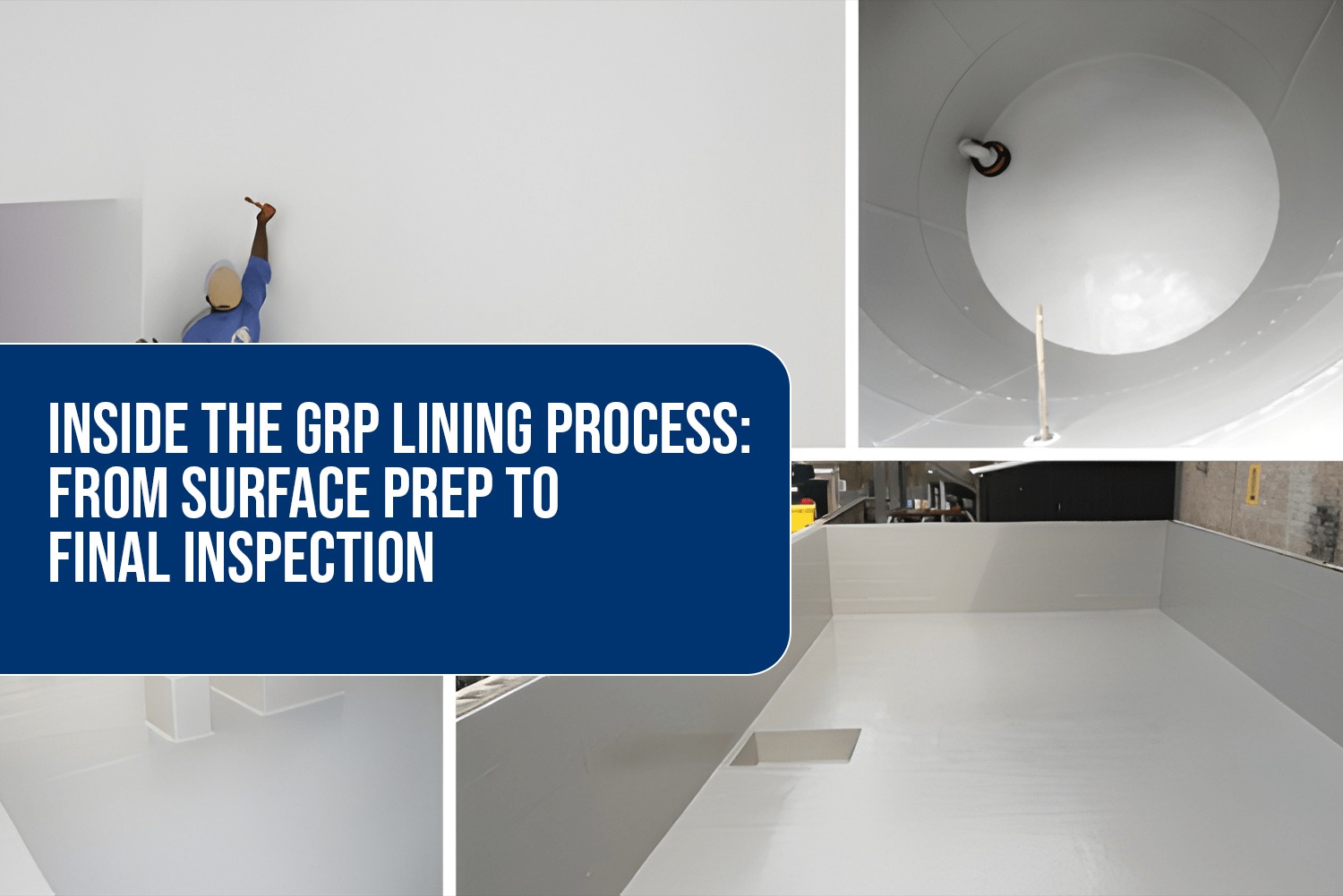
In industries where corrosion, chemical exposure, and leakage are constant threats, GRP (Glass Reinforced Plastic) lining has emerged as one of the most reliable protection systems available. Whether used inside storage tanks, pipelines, sumps, or concrete containment areas, GRP lining offers a long-lasting, seamless, and corrosion-resistant barrier that outperforms traditional coatings.
But what actually goes into a professional GRP lining project? From the first phase of surface preparation to the final inspection and testing, each step plays a critical role in ensuring structural integrity and longevity.
At Petroline, we follow a meticulous, standards-driven GRP lining process designed to meet international quality benchmarks and deliver consistent, durable performance. Let’s take a closer look inside this process.
Step 1: Detailed Surface Preparation
The success of any GRP lining system begins long before the first layer of fiberglass is applied. Proper surface preparation ensures strong adhesion between the substrate and the GRP laminate — and ultimately determines the lining’s performance and service life.
For concrete surfaces, preparation involves:
- Checking moisture content and ensuring it’s below acceptable limits.
- Repairing cracks, honeycombs, and voids with compatible repair mortar.
- Grinding, shot-blasting, or scarifying the surface to remove laitance and expose sound material.
For steel surfaces, the process includes:
- Abrasive blasting to achieve a near-white finish (Sa 2½ as per ISO 8501-1).
- Achieving the recommended surface profile for mechanical keying.
- Cleaning off contaminants such as oil, grease, and rust before applying primer.
Environmental parameters such as temperature, humidity, and dew point are continuously monitored. At Petroline, our supervisors ensure surface profiles and cleanliness meet strict QA requirements before proceeding to the next stage.
Step 2: Primer and Bonding Application
Once the surface is properly prepared, a primer or bonding coat is applied to create a secure interface between the substrate and the laminate. This thin layer acts as an adhesive foundation, sealing micro-pores in the concrete or steel and preventing moisture ingress.
The primer type depends on the chosen resin system — typically isophthalic polyester or vinyl ester resins for GRP linings. Vinyl ester primers are used where chemical resistance is paramount, such as in acid tanks or wastewater treatment plants.
After primer application, the surface is inspected for uniform coverage and tackiness. A clean, tack-free yet slightly adhesive surface ensures optimal bonding with the first lamination layer.
Step 3: Lamination Process
The lamination phase is where the GRP lining truly takes shape. This process involves layering fiberglass reinforcement materials and impregnating them with resin to create a durable, corrosion-resistant composite barrier.
Typical layering includes:
- Chopped Strand Mat (CSM) – provides multidirectional strength and even resin distribution.
- Woven Roving – adds high tensile strength and impact resistance.
- Additional CSM layers – enhance structural integrity and ensure uniform thickness.
The total laminate thickness typically ranges from 3 mm to 6 mm, depending on service conditions and the chemical exposure level.
During application, each layer is carefully wet-out with resin to eliminate air bubbles and voids. Entrapped air can lead to delamination, so technicians use rollers to achieve a dense, uniform composite.
Curing time between layers is strictly controlled to ensure proper bonding. At Petroline, all lamination work is carried out by certified applicators under controlled environmental conditions, ensuring consistent results across every square meter of lining.
Step 4: Finishing and Topcoat Application
After the laminate structure is complete, a chemical-resistant topcoat or gelcoat is applied. This finishing layer enhances chemical and UV resistance while improving surface smoothness — a vital factor in hygiene-sensitive or fluid-handling environments.
Depending on the client’s requirements, color-coded topcoats can be used to distinguish between chemical types or service zones (for example, blue for potable water, red for acid tanks, green for effluent).
A smooth, glossy topcoat not only improves the aesthetic but also simplifies maintenance and inspection throughout the lining’s service life.
Step 5: Curing and Post-Cure Inspection
Curing is the process through which the resin fully polymerizes and achieves its mechanical and chemical properties. Insufficient curing can lead to reduced resistance, poor adhesion, or blistering under service conditions.
To prevent this, Petroline ensures proper curing through:
- Maintaining optimal ambient temperature and humidity.
- Allowing adequate cure time as specified by the resin manufacturer.
- In some cases, applying controlled post-curing with warm air circulation to achieve complete cross-linking.
Once curing is complete, the lining undergoes an initial inspection to verify surface finish, gloss, and absence of defects such as cracks, pinholes, or resin-starved areas.
Step 6: Testing and Final Quality Inspection
Before handover, every GRP lining installation undergoes rigorous testing and quality assurance checks. These confirm that the system meets specified performance criteria and safety standards.
Common tests include:
- Spark / Holiday Test (ASTM D5162): Detects pinholes, voids, or discontinuities in the laminate using a high-voltage probe.
- Adhesion Test (ASTM D4541): Measures the bond strength between the GRP lining and the substrate.
- Thickness Measurement: Ensures laminate thickness is within design tolerance (usually verified by DFT gauges or ultrasonic testing).
- Visual and Tap Testing: Identifies delaminations, overlaps, or surface imperfections.
All results are documented in detailed QA/QC reports, including test readings, calibration certificates, and photographic evidence. Only after passing these checks is the system approved for commissioning.
Quality and Standards at Petroline
Every GRP lining project handled by Petroline follows internationally recognized standards, such as:
- ISO 14692 – for reinforced thermosetting resin systems.
- BS 4994 – for design and construction of vessels and tanks in reinforced plastics.
- ASTM D2563 – for visual inspection of fiberglass-reinforced plastic laminates.
By aligning with these standards and combining technical precision with skilled workmanship, Petroline ensures every installation achieves maximum protection, chemical resistance, and service life — whether it’s a chemical plant, desalination facility, or wastewater treatment unit.
Conclusion
The GRP lining process is much more than applying fiberglass and resin — it’s a carefully engineered system built on precision, control, and quality assurance. From surface preparation and primer application to lamination, curing, and testing, every stage directly impacts the performance and longevity of the structure it protects.
At Petroline, we take pride in mastering every phase of this process, delivering linings that withstand harsh industrial environments while reducing maintenance and downtime for our clients.
If you’re planning a new installation or refurbishing existing tanks and structures, reach out to Petroline for expert consultation on GRP and fiberglass lining solutions designed for long-term industrial protection.