
Dubai’s concrete structures face continuous stress from extreme temperature swings, high humidity, chloride-laden coastal air, and occasional heavy rain events. Hairline cracks that appear in basement walls, podium slabs, water tanks, retaining walls, and high-rise cores can quickly become pathways for water and salts. Once moisture reaches the reinforcement, corrosion begins, expanding the steel and accelerating further cracking. As a result, professional crack injection services in Dubai close these pathways from the inside, restore load transfer, and protect the embedded steel before expensive reconstruction becomes necessary.
Unlike surface sealants that only cover the visible crack, crack injection forces low-viscosity epoxy or polyurethane resins deep into the full depth of the crack under controlled pressure. Consequently, the process creates a permanent internal seal that bonds the crack faces or remains flexible enough to accommodate residual movement. For property owners, facility managers, and main contractors across Dubai Marina, Business Bay, DIFC, Jumeirah Lake Towers, and industrial zones, timely crack injection services in Dubai deliver measurable protection at a fraction of the cost of major concrete replacement.
What Is Crack Injection and How Does It Work?
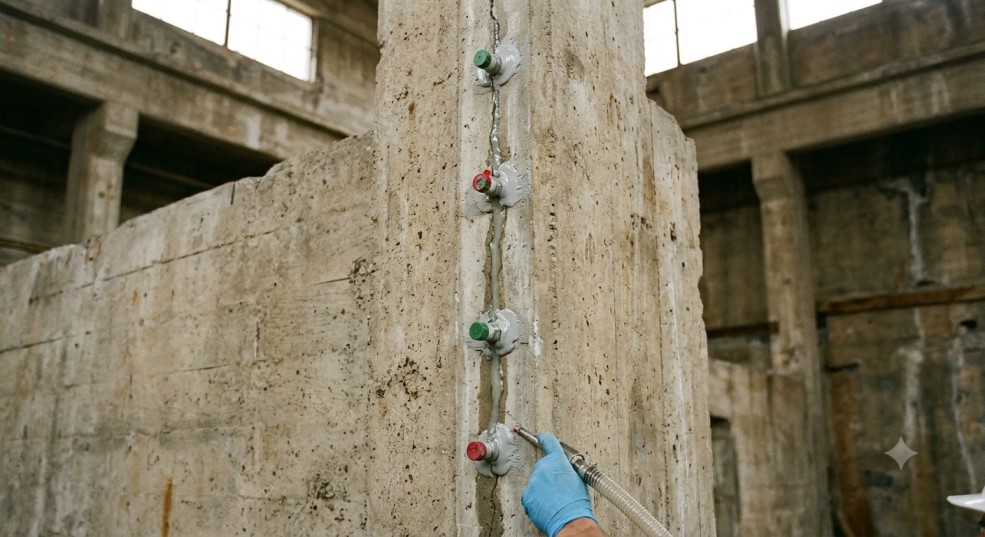
Crack injection is a pressure-driven process that introduces specialised resins into concrete cracks through mechanical packers. First, technicians assess crack width, movement potential, moisture condition, and structural role. Next, they drill holes along the crack line at calculated intervals and fix the packers. Finally, they inject the resin until it appears at the next port, confirming full penetration.
Two primary resin systems dominate crack injection services in Dubai:
Epoxy resin injection – Low-viscosity structural epoxy suits dormant (non-moving) cracks. Once cured, the epoxy forms a rigid bond stronger than the parent concrete in tension. In this way, the injection restores monolithic behaviour and re-establishes the original load path through beams, columns, slabs, and walls. Typical injectable crack widths start from 0.1 mm.
Polyurethane (PU) resin injection – Flexible or foam-forming polyurethane works best for active or water-bearing cracks. Hydrophilic or hydrophobic PU expands on contact with moisture, displacing water and creating a flexible, watertight seal that can accommodate limited future movement. Therefore, this system becomes the first choice for basement walls, lift pits, water tanks, and retaining walls under hydrostatic pressure.
In many projects a hybrid sequence is applied: PU foam first stops the active leak, followed by epoxy injection once the crack is dry. This approach delivers both waterproofing and structural restoration. Petroline’s crack injection services in Dubai follow this diagnostic-driven method on every site.
Why Dubai Concrete Structures Need Crack Injection
Dubai’s climate creates unique conditions that accelerate crack formation and deterioration. Several factors stand out:
Thermal cycling – Daytime temperatures regularly exceed 45 °C while night-time temperatures drop sharply. Repeated expansion and contraction generate tensile stresses that produce hairline cracks in slabs, beams, and façade elements.
Chloride exposure – Coastal humidity and saline groundwater introduce chlorides that penetrate cracks and attack reinforcement. Corrosion products expand up to six times the original steel volume, widening existing cracks and creating new ones.
Settlement and construction practices – Differential settlement on reclaimed land and variable construction quality from earlier building cycles leave many structures with dormant cracks. These cracks become active once water finds a path.
When left untreated, these cracks allow continuous moisture ingress. Studies of UAE concrete structures show that chloride-induced corrosion can reduce the service life of untreated cracked elements by 30–50 %. Professional crack injection services in Dubai interrupt this cycle at the earliest practical stage.
How Crack Injection Protects Concrete Structures
1. Restores Structural Continuity
When technicians inject a structural crack with correctly specified epoxy, the resin bonds the two faces and re-establishes tensile and shear transfer. Laboratory and site data confirm that a properly executed epoxy injection can restore load-carrying capacity to levels matching or exceeding the original concrete section. This outcome proves critical for beams, columns, transfer slabs, and shear walls in high-rise towers across Dubai.
2. Stops Water and Chloride Ingress
Polyurethane injection creates an impermeable barrier inside the crack. In basements and water-retaining structures, this barrier prevents continuous seepage that would otherwise keep reinforcement wet. By eliminating the moisture pathway, crack injection significantly slows chloride-induced corrosion and carbonation advance.
3. Minimal Disruption and Cost Efficiency
Unlike full concrete breakout and replacement, injection requires only small drilled ports. Occupied buildings, operational car parks, and water tanks can often remain in service. Typical residential or commercial crack injection campaigns finish in one to two days. Moreover, the cost of early crack injection services in Dubai usually represents a small fraction of the expense of later structural strengthening or reconstruction.
4. Suitable for Finished and Inaccessible Areas
Injection can be performed from the negative side of a wall or from limited access points. This capability makes the method ideal for finished basements, wet areas behind tiles, lift pits, and underground tanks where full membrane replacement proves impractical.
Key Applications of Crack Injection in Dubai
Professional crack injection services in Dubai are routinely applied to the following elements:
• Basement walls and raft slabs – stopping rising damp and lateral seepage
• Podium and roof slabs – sealing thermal and shrinkage cracks
• Water tanks and fire-fighting reservoirs – achieving watertightness without full relining
• Retaining walls and lift pits – managing hydrostatic pressure
• High-rise cores, beams, and transfer structures – restoring structural continuity
• Parking decks and industrial floors – preventing progressive deterioration under traffic loads
For a broader view of structural concrete repair options, see Petroline’s guide to concrete repairs in UAE.
The Professional Crack Injection Process
A reliable crack injection sequence follows these clear steps:
1. Diagnostic assessment – Technicians map cracks, measure widths, test moisture, and determine movement status. When reinforcement layout or cover depth is critical, they also use GPR scanning.
2. Surface preparation – The team cleans the area, removes loose material, and seals the crack surface with epoxy putty where required.
3. Packer installation – Workers drill injection ports at calculated centres and fix mechanical packers securely.
4. Resin injection – Specialists inject the selected epoxy or polyurethane system under controlled pressure until full saturation is confirmed.
5. Finishing and documentation – After curing begins, the crew removes packers, patches the surface, and records injection volumes and pressures for quality assurance.
Benefits of Choosing Professional Crack Injection Services in Dubai
• Permanent internal sealing rather than temporary surface covering
• Restoration of structural capacity on dormant cracks
• Effective stoppage of active water leaks under hydrostatic head
• Reduced risk of reinforcement corrosion and subsequent spalling
• Minimal disruption to building operations and finishes
• Cost-effective alternative to large-scale concrete replacement
Petroline Technical Services delivers these outcomes through experienced site teams, pressure-controlled equipment, and resin systems selected for Dubai’s temperature and moisture conditions. Furthermore, you can learn more about the benefits of professional crack injection services in UAE.
Protect Your Structure with Expert Crack Injection Services in Dubai
Cracks in Dubai’s concrete buildings are not merely cosmetic. Instead, they serve as the entry points for water, chlorides, and progressive structural deterioration. Professional crack injection services in Dubai close these pathways from the inside, restore load paths where required, and extend the service life of basements, slabs, tanks, and high-rise elements.
Petroline Technical Services provides diagnostic assessment, resin selection matched to site conditions, and pressure-controlled injection executed by experienced teams. Whether you manage a villa basement, a commercial podium, or an industrial facility, early crack injection remains one of the most cost-effective protective measures available.
Contact Petroline today for a free site inspection and a clear recommendation on the right crack injection services in Dubai for your structure.
FAQs
1. How much do crack injection services in Dubai cost?
Pricing depends on crack length, depth, accessibility, and resin type. Many contractors quote per injection packer or per linear metre. A free site inspection remains the only reliable way to obtain an accurate figure. In addition, early intervention almost always proves more economical than waiting until corrosion or active leakage has progressed.
2. Is crack injection a permanent solution?
When specialists match the correct resin to the crack condition (epoxy for stable structural cracks, flexible PU for moving or wet cracks) and execute the injection properly, the repair is considered long-term. Structural epoxy bonds can outlast the surrounding concrete if the original cause of cracking has been addressed.
3. Can crack injection stop active water leaks in basements?
Yes. Polyurethane foam resins are specifically formulated to react with water, expand, and form a closed-cell seal under pressure. As a result, this method is widely used for basement walls, lift pits, and water tanks across Dubai without requiring external excavation.
4. What is the difference between epoxy and polyurethane crack injection?
Epoxy creates a rigid, high-strength bond ideal for restoring structural integrity in dry, dormant cracks. In contrast, polyurethane remains flexible or foams on contact with moisture and is chosen for waterproofing and for cracks that may still experience limited movement.
5. How long does a typical crack injection project take?
Small residential or localised commercial repairs are often completed within a few hours to one day. Larger campaigns involving multiple basement walls or extensive podium slabs may take two to three days, depending on access and the number of cracks.