
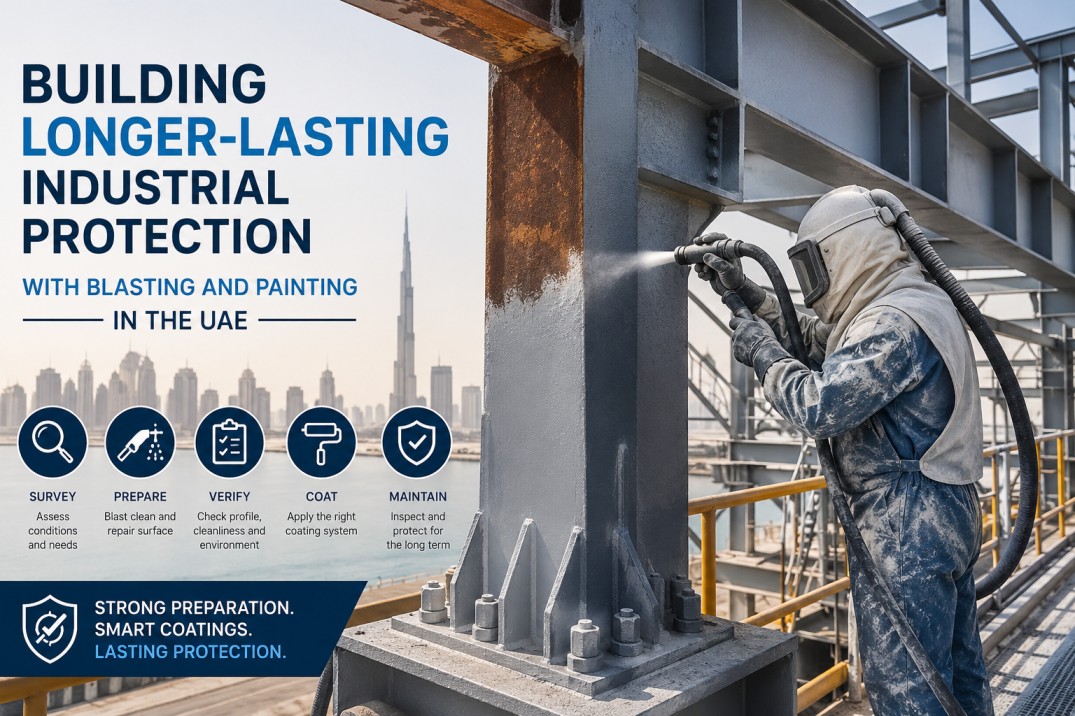
Why industrial steel needs a system
Industrial steel in the UAE works in a demanding environment. Heat, humidity, airborne dust, saline air near the coast, condensation and process contamination can undermine an otherwise sound coating. The answer is not simply to apply a thicker layer of paint; it is to control the full protection chain. This guide explains how blasting and painting in UAE projects can improve coating adhesion, reduce corrosion exposure and support predictable maintenance planning.
| A useful principle Paint protects only as well as the surface beneath it. If rust, salts, oil or weak old coating remains, the new film may lose adhesion or develop early blistering and underfilm corrosion. |
What blasting actually achieves
Abrasive blasting uses a controlled stream of abrasive media to remove rust, mill scale, old coatings and contaminants. It also creates an anchor profile: microscopic peaks and valleys that give the primer a mechanical key. The specified cleanliness grade and surface profile should match the coating manufacturer’s technical data sheet and the project specification.
For many high-performance systems, ISO 8501-1 Sa 2½—very thorough blast cleaning—is specified. The standard describes a surface free from visible oil, grease, dirt, mill scale, rust, paint and foreign matter, apart from minimal firmly adhering traces. The visual grade alone is not enough: profile, dust, soluble salts and environmental conditions also need verification. [web:2][web:10]
The protection workflow
1. Inspect and define the service
Record substrate condition, existing coating, operating temperature, immersion or splash exposure, chemical contact, access constraints and repair history.
2. Clean and repair
Remove grease and deposits before blasting. Repair weld spatter, sharp edges, laminations and damaged steel where required.
3. Blast to the specified grade
Use suitable abrasive, pressure, nozzle distance and containment. A typical coating specification may call for Sa 2½ and a controlled profile; one manufacturer example specifies a 45–85 micron profile, but the project system should govern. [web:11]
4. Verify before painting
Check cleanliness, surface profile, dust and soluble salts. Measure steel temperature, air temperature, relative humidity and dew point; do not coat when condensation risk is present.
5. Apply the coating system
Use the compatible primer, intermediate and finish coat. Stripe-coat welds, edges, bolts and difficult geometries where specified, then apply each coat at the required wet and dry film thickness.
6. Inspect and hand over
Document batch numbers, environmental readings, DFT readings, defects, repairs, photographs and final acceptance checks.
Choosing a coating approach
The right system depends on the asset—not on a generic “anti-rust paint” label. A coating engineer should consider corrosion category, service temperature, chemical exposure, UV, abrasion, immersion and the consequences of failure.
| Asset or exposure | Typical system logic | Site example |
| Structural steel | Zinc-rich or anticorrosive primer + epoxy build coat + UV-resistant topcoat where needed. | Warehouse frames, platforms and access steel. |
| Tanks and vessels | Select lining for the stored product, immersion condition and operating temperature; confirm cure and holiday-testing requirements. | Water, process or chemical storage. |
| Pipelines and supports | Prioritise edge coverage, splash zones, mechanical damage resistance and maintainability. | Pipe racks, supports and exposed utility lines. |
| Marine or coastal exposure | Use a specification appropriate to high salinity and persistent moisture, with strong inspection controls. | Jetties, coastal plants and port-side equipment. |
UAE-specific execution controls
UAE projects often combine high daytime temperatures with humidity, dust and coastal chloride exposure. These conditions can shorten the safe application window and increase the importance of containment, abrasive cleanliness, dew-point checks and rapid primer application after blasting. Coastal and offshore specifications may require tighter soluble-salt limits than ordinary atmospheric service; the contract specification and coating manufacturer’s data should control. [web:7][web:12]
· Schedule blasting and painting around measured conditions, not the clock.
· Use clean, dry compressed air and prevent blasted steel from being re-contaminated by dust or salts.
· Plan ventilation and dehumidification for enclosed areas such as tanks, but verify that airflow does not introduce contamination.
· Protect adjacent equipment and manage spent abrasive, dust and paint waste under the site’s HSE and environmental procedures.
· Use competent inspectors and calibrated instruments for profile, environmental readings and dry-film thickness.
Illustrative maintenance-risk graph
A coating system is not a substitute for inspection. This illustrative index shows how defects can increase maintenance exposure when surface preparation and environmental controls are weak. It is a planning visual—not a measured Petroline Tech result.
Unprepared steel ████████████████████ 100
Basic preparation ██████████████░░░░░░ 68
Controlled blast + coating██████░░░░░░░░░░░░░░ 32
Planned inspection ████░░░░░░░░░░░░░░░░ 20
Risk index (illustrative, lower is better)
Common causes of premature failure
Painting over contamination
Oil, dust, salts or moisture can prevent adhesion and accelerate osmotic blistering.
Wrong profile
A profile that is too shallow may reduce mechanical key; one that is too coarse can leave peaks under-protected or consume excess coating.
Poor edge treatment
Corners, welds, bolts and cut-outs often receive less film thickness and become early corrosion sites.
Ignoring recoat windows
Recoating outside the product’s minimum or maximum interval can compromise intercoat adhesion.
Weak records
Without readings, batch details and repair history, it is difficult to prove quality or plan future maintenance.
Example: protecting a pipe-rack extension
Imagine a coastal industrial facility adding 1,200 m² of carbon-steel pipe rack. A practical plan would begin with a condition survey and coating specification, followed by degreasing, repair of welds and edges, abrasive blasting to the specified cleanliness grade, environmental verification, primer application, stripe coating and controlled build coats. The handover package would include area maps, inspection readings, product batch numbers, photographs and a schedule for touch-up inspections.
| Why the example matters The project is not judged by how quickly the first coat is sprayed. It is judged by whether the complete, compatible system remains intact in the asset’s actual service environment. |
How Petroline Tech can support projects
Petroline Tech can help industrial clients plan and execute surface preparation and protective coating work with a focus on substrate condition, specification compliance, application control and clear documentation. The scope may include steel preparation, abrasive blasting, industrial painting, repair coating, inspection coordination and maintenance advice. Request a site assessment through petrolinetech.com so the recommendation can be matched to the asset, exposure and shutdown plan.
FAQs
1. What is blasting and painting in UAE?
It is a coordinated industrial surface-preparation and protective-coating process. Blasting removes corrosion and contamination while creating an anchor profile; painting applies a specified coating system to protect the prepared substrate.
2. Why is Sa 2½ blasting used before industrial painting?
Sa 2½ is a very thorough blast-cleaning grade that removes visible oil, grease, dirt, mill scale, rust, coatings and foreign matter except minimal firmly adhering traces. It is commonly selected when strong adhesion and long-term corrosion protection are required.
3. How do I choose an industrial coating for UAE conditions?
Start with exposure: coastal or inland atmosphere, immersion, chemicals, temperature, UV, abrasion, and access for future maintenance. Then select a compatible system and confirm its preparation, profile, thickness, curing and inspection requirements with the manufacturer and project engineer.
4. How often should industrial steel be inspected after painting?
There is no single interval for every asset. Set the frequency according to exposure, the consequences of failure, the coating condition, and the owner’s integrity plan. Inspect more frequently where there is salt, standing water, mechanical damage or difficult access.
5. How can coating failure be prevented?
Prevent it through correct specification, complete cleaning, controlled blasting, verified profile and salts, dew-point management, correct film thickness, edge and weld treatment, recoat-window control, and complete quality records.