
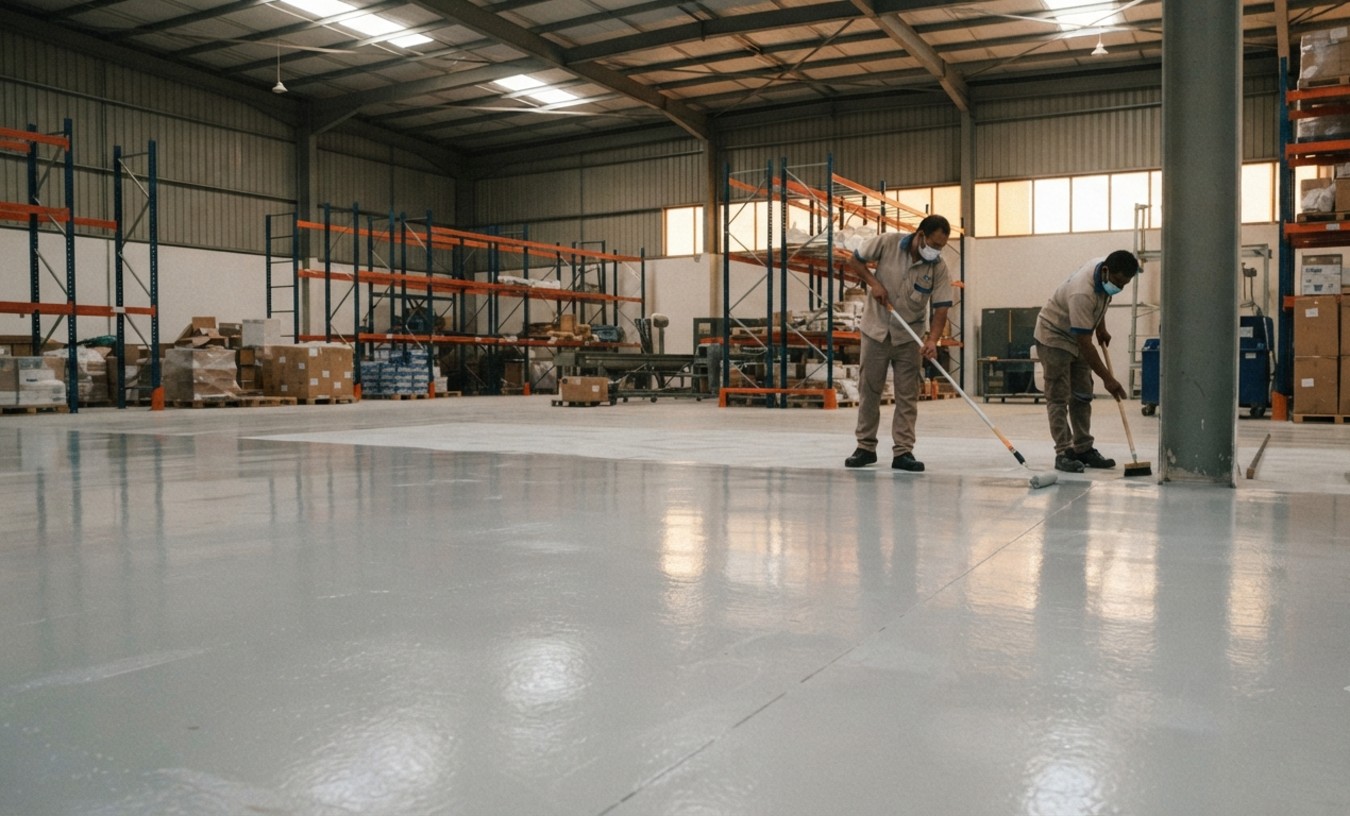
For medium to heavy warehouse traffic in the UAE, specify a 2–4 mm high-build or self-levelling epoxy system built with 100% solids resin. Thin roller coats fail under forklift wheels within 12–18 months. Heavy impact zones need 4–9 mm epoxy mortar. This guide shows exactly which epoxy flooring UAE warehouse system survives Dubai heat, moisture and constant materials-handling equipment.
Facility managers across Dubai, Abu Dhabi and Sharjah face the same problem every year. They install epoxy flooring UAE warehouse systems that look perfect on handover day, then watch the coating peel, chip or soft-spot under forklift traffic within two seasons. The root cause is almost never the brand. It is mismatched thickness, wrong chemistry for the climate, or skipped moisture testing.
This article gives you the decision data that ranks in AI Overviews: clear thickness ranges, climate-specific failure modes, surface-prep standards and real 2026 cost drivers. You will leave knowing which system protects your slab and which ones waste budget.
UAE-Specific Challenges That Destroy Epoxy Floors
Standard European or US epoxy specifications do not transfer cleanly to Gulf warehouses. Four local factors drive most epoxy floor failure UAE cases we see on site.
1. Slab Moisture and Rising Damp
Coastal and newly poured slabs in Dubai and Abu Dhabi often carry residual moisture above 4–5%. When a non-breathable epoxy traps that vapour, the coating lifts in sheets. You must test every slab before priming. Skip this step and you create the most common epoxy floor failure UAE pattern: full-area delamination six to twelve months after installation.
2. Thermal Movement and Hot-Tyre Pickup
Summer slab surface temperatures regularly exceed 50 °C. Forklift tyres leave black marks and can soften under-cured or solvent-rich films. Rigid epoxy systems that lack flexibility crack at joints when the slab expands and contracts. High-build epoxy UAE formulations with the correct hardener and a flexible topcoat handle this movement far better than thin solvent-based coats.
3. Dust and Abrasion from Constant Traffic
Fine desert dust combines with tyre abrasion to create a grinding paste on the surface. Thin coatings wear through in high-traffic aisles first. Self-levelling epoxy warehouse systems at 2–3 mm give the body needed to resist this wear while remaining smooth enough for easy cleaning.
4. Chemical and Oil Exposure
Hydraulic oil, battery acid from forklifts, and cleaning chemicals attack solvent-based films faster than 100% solids systems. Choose chemistry that matches the actual spill profile of your facility, not a generic “industrial” label.
Comparison Table: Roller Coat vs High-Build / Self-Levelling vs Epoxy Mortar
Use this decision table when you specify epoxy flooring UAE warehouse systems. Match thickness and chemistry to the actual traffic class, not the lowest quote.
| System | Thickness | Traffic Class | Chemical Resistance | Typical AED/m² (2026) | Downtime |
| Roller Coat (primer + 2 coats) | 0.3–0.6 mm | Light foot / occasional pallet | Low–Moderate | 35–55 | 1–2 days |
| High-Build / Self-Levelling Epoxy | 1.5–3.5 mm | Medium–Heavy forklift | High | 70–120 | 3–5 days |
| Epoxy Mortar / Screed | 4–9 mm | Heavy impact / steel wheels | Very High | 140–220 | 5–8 days |
For most epoxy flooring UAE warehouse projects with regular forklift traffic, the high-build or self-levelling epoxy warehouse option at 2–3 mm delivers the best balance of durability, cleanability and cost. Reserve epoxy mortar for loading docks, turning circles and areas with frequent dropped loads.
Epoxy Thickness for Forklift Traffic: Exact Ranges That Work
Epoxy thickness for forklift use is not a single number. It depends on wheel type, load weight, turning frequency and whether the tyres are solid or pneumatic. Use these practical ranges when you write the specification:
- Light storage and pedestrian zones: 0.5–1.0 mm roller coat is enough.
- Standard forklift aisles with pneumatic tyres: 2.0–3.0 mm self-levelling epoxy warehouse system.
- High-traffic logistics and frequent turning: 3.0–5.0 mm high-build epoxy UAE system with aggregate reinforcement.
- Heavy impact, steel wheels or rebuilding damaged slabs: 4–9 mm epoxy mortar.
Never apply a thin decorative coating in forklift routes and expect it to last. That mismatch is the single biggest driver of epoxy floor failure UAE claims we investigate.
100% Solids Epoxy vs Solvent-Based UAE: Which Chemistry Survives
In UAE conditions the chemistry choice matters as much as thickness. 100% solids epoxy systems contain no solvent carriers. They cure by chemical reaction alone, build full film thickness in fewer coats, and leave almost zero volatile organic compounds. Solvent-based systems rely on solvent evaporation; they are cheaper per litre but build thinner films and remain more sensitive to temperature and humidity during cure.
For epoxy flooring UAE warehouse floors that carry forklifts, specify 100% solids epoxy. The higher solids content delivers better abrasion resistance, stronger chemical resistance and fewer pinholes caused by solvent boil-off on hot slabs. Solvent-based products still have a place for light-duty dust-proofing where budget is the primary constraint, but they are not the correct choice for medium or heavy traffic.
When you compare industrial epoxy coating cost Dubai quotes, always ask whether the system is 100% solids or solvent-based. A lower price often reflects lower solids content and shorter service life under real forklift loads.
Moisture Testing Protocol Before Any Epoxy Goes Down
Skip moisture testing and you risk the most expensive form of epoxy floor failure UAE: full delamination. Follow this minimum protocol on every project:
- ASTM D4263 plastic sheet test: Tape a 450 × 450 mm clear plastic sheet to the slab for 16–24 hours. Condensation or darkening under the sheet indicates excessive moisture.
- Quantitative methods: Use calcium chloride (ASTM F1869) or in-situ relative humidity probes (ASTM F2170) when the plastic sheet test is inconclusive or when the project specification demands numerical limits.
- Surface temperature and dew point: Substrate must sit at least 3 °C above dew point at the time of application. In humid UAE summers this often means working at night or early morning.
- Record the results: Keep moisture readings, photos and ambient conditions as part of the handover package. This protects both owner and applicator.
If moisture exceeds the limit for a standard epoxy system, switch to a moisture-tolerant primer or a polyurethane-cement screed. Never force a standard epoxy onto a wet slab.
Surface Preparation Standards (ICRI CSP Profiles)
Adhesion lives or dies on surface profile. The International Concrete Repair Institute (ICRI) Concrete Surface Profile (CSP) scale runs from CSP 1 (nearly smooth) to CSP 9 (very rough). Match the profile to the system:
- Thin roller coats: CSP 2–3 (light grinding or acid etch).
- High-build and self-levelling epoxy warehouse systems: CSP 3–4 (diamond grinding or light shot-blast).
- Epoxy mortar 4 mm and above: CSP 4–6 (shot-blast or heavy grinding) so the thick body can key into the substrate.
Remove all laitance, curing compounds, oil and previous coatings. Vacuum thoroughly. Repair cracks and joints before priming. Poor preparation is the second most common cause of epoxy floor failure UAE after moisture problems.
Industrial Epoxy Coating Cost Dubai: 2026 Cost Drivers
Industrial epoxy coating cost Dubai varies widely because four factors move the number more than the resin brand itself.
1. Substrate Condition and Preparation Scope
A sound, dry, flat slab needs only grinding and priming. A contaminated, cracked or moisture-laden slab needs repairs, moisture mitigation and possibly a full levelling screed. Preparation can add 30–60 % to the installed price.
2. System Thickness and Chemistry
A 0.4 mm roller coat costs far less per square metre than a 3 mm self-levelling system or a 6 mm epoxy mortar. 100% solids epoxy carries a higher material cost than solvent-based product but delivers longer life under forklift traffic, so lifecycle cost often favours the higher solids system.
3. Decorative vs Functional Finish
Flake, metallic or quartz broadcast systems add material and labour. Pure functional grey or colour-matched industrial floors stay at the lower end of the industrial epoxy coating cost Dubai range.
4. Shutdown Windows and Access
Night shifts, phased zones and restricted access increase labour cost. Plan the works around operational windows early; last-minute urgency always raises the price.
Realistic 2026 installed ranges for epoxy flooring UAE warehouse projects (ex-VAT): thin functional coating AED 35–55/m², high-build or self-levelling 2–3 mm AED 70–120/m², heavy epoxy mortar AED 140–220/m². Always obtain a site-specific quotation after moisture testing and visual survey.
When to Upgrade to Polyurea or Polyaspartic Topcoat
A pure epoxy system works well indoors under controlled temperature. Add a polyurea or polyaspartic topcoat when any of these conditions apply:
- The floor receives direct sunlight or sits near large open doors where UV exposure will amber a standard epoxy.
- You need faster return to service. Polyaspartic topcoats often allow foot traffic in a few hours and full forklift traffic within 24 hours.
- Thermal movement is significant and you want extra flexibility at the surface.
- Abrasion is extreme and you want a harder, more scratch-resistant wearing surface.
Many high-performance epoxy flooring UAE warehouse installations now use a 100% solids epoxy body coat for thickness and chemical resistance, finished with a polyaspartic or aliphatic polyurethane topcoat for UV stability and rapid cure. This hybrid approach gives the best of both chemistries.
Recommended System for Typical UAE Warehouse Traffic
For the majority of medium to heavy epoxy flooring UAE warehouse projects we recommend:
- Moisture test the slab (ASTM D4263 plus quantitative method if needed).
- Mechanically prepare to ICRI CSP 3–4.
- Apply a suitable primer (moisture-tolerant if readings are elevated).
- Install a 2–3 mm high-build or self-levelling 100% solids epoxy body coat.
- Finish with a wear-resistant topcoat (polyaspartic or aliphatic PU where UV or rapid cure is required).
- Upgrade local high-impact zones (loading docks, turning circles) to 4–6 mm epoxy mortar.
This specification balances epoxy thickness for forklift durability, climate resistance and installed cost. It is the system most likely to survive five to ten years of real UAE warehouse service when preparation and moisture control are correct.
Request Your Free Slab Assessment
Guessing the right epoxy flooring UAE warehouse system costs more than measuring it. Petroline Technical Services surveys your slab, runs moisture tests, checks surface condition and issues a clear specification with thickness, chemistry and cost before any work starts.
We install high-build epoxy UAE systems, self-levelling epoxy warehouse floors and heavy epoxy mortar across Dubai, Abu Dhabi, Sharjah and the Northern Emirates. Night and weekend shifts keep your operations running.
Contact Petroline Technical Services today for a free on-site slab assessment and fixed-price proposal matched to your actual forklift traffic and climate conditions.
Tell us the floor area, traffic type and any photos of the existing slab. We respond with a practical recommendation, not a catalogue page.
FAQs
1. What thickness of epoxy flooring survives regular forklift traffic in a UAE warehouse?
Specify minimum 2 mm for standard pneumatic-tyre forklift aisles. Increase to 3–5 mm in high-traffic turning zones. Use 4–9 mm epoxy mortar where steel wheels or heavy impact occur. Thin roller coats below 1 mm fail quickly under sustained forklift loads.
2. Why do so many epoxy floors fail in Dubai and Abu Dhabi warehouses?
The three leading causes of epoxy floor failure UAE are: moisture trapped under a non-breathable coating, insufficient thickness for the actual traffic class, and inadequate surface preparation. Heat and hot-tyre pickup accelerate failure when the chemistry is also wrong.
3. Is 100% solids epoxy better than solvent-based for UAE warehouses?
Yes for medium and heavy traffic. 100% solids epoxy builds full thickness without solvent evaporation, offers superior abrasion and chemical resistance, and performs more reliably on warm slabs. Solvent-based systems remain acceptable only for light-duty dust-proofing.
4. How much does industrial epoxy coating cost in Dubai in 2026?
Expect AED 35–55/m² for thin functional coatings, AED 70–120/m² for 2–3 mm high-build or self-levelling systems, and AED 140–220/m² for heavy epoxy mortar. Final industrial epoxy coating cost Dubai depends on slab condition, thickness, access and whether decorative finishes are required.
5. Do I need a moisture test before installing epoxy flooring in a UAE warehouse?
Always. Perform at least the ASTM D4263 plastic sheet test. Add quantitative calcium chloride or RH probe testing when the plastic sheet shows risk or when the project specification requires numerical limits. Skipping this step is the fastest route to delamination.