
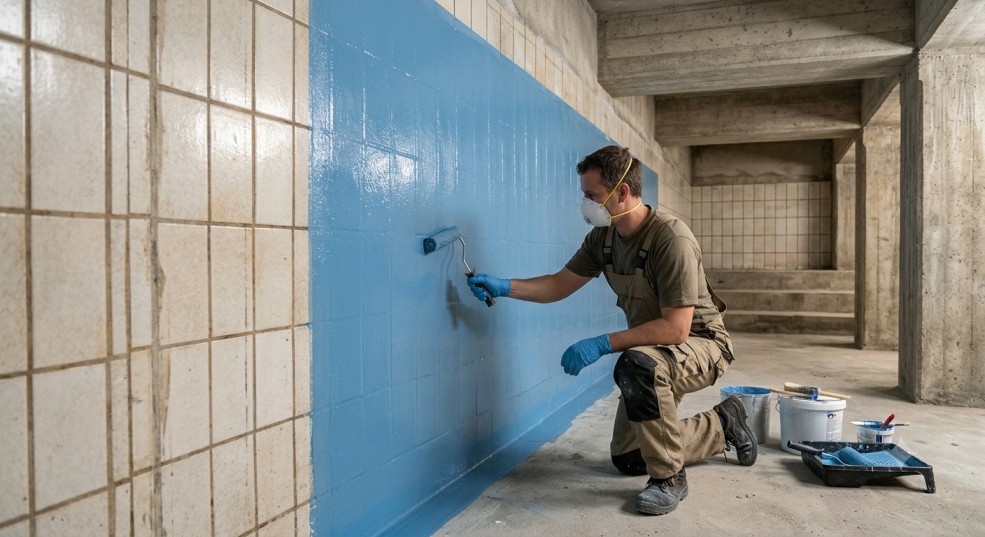
Most underground tanks in UAE villas and residential towers were tiled when they were built. Ten or fifteen years later the grout has opened, water sits behind the tiles and the tank starts losing water or growing algae. Stripping every tile is slow, noisy and costly. Sound tiles can stay. GRP lining for water tanks can be laminated directly over them once the surface is tested and prepared correctly.
Quick answer: Yes, GRP lining for water tanks can be applied over existing tiles when the tiles are firmly bonded, the glaze is ground off and the finished laminate is 3 to 4 mm thick. Hollow or loose tiles must be removed and filled first.
Why Tiled Underground Tanks Start Leaking
Tiles are a finish, not a waterproofing system. Cement grout is porous, and the bond line behind each tile gives water a path. Three UAE conditions speed up the damage:
- Shallow groundwater in many coastal areas pushes against the outside of tank walls.
- Summer air temperatures above 45°C expand and contract the structure daily, which cracks grout lines.
- Warm water and humidity above 80% feed algae in open joints.
Watch for these warning signs:
- Water level drops with no pump or supply fault
- Hollow sound when tapping tiles
- White salt deposits on the walls
- Green or black growth in grout lines
- Musty smell at the access cover
When GRP Lining Over Tiles Works, and When It Does Not
Tile condition decides whether GRP lining for water tanks can go over the existing surface. A tap test with a small hammer takes about two hours on a 150 m² tank and shows most of what you need to know.
| Tile condition | Recommended action |
|---|---|
| Firmly bonded, solid sound | Grind the glaze and line over the tiles |
| Isolated hollow tiles | Remove, fill with repair mortar, level, then line |
| Widespread hollow sound or lifting tiles | Strip to bare concrete |
| Cracks showing through tiles | Seal with crack injection before lining |
| Damp or leaking substrate | Stop the leak and dry the tank first |
Lining over failed tiles only hides the problem. The laminate is strong, but it is only as good as the bond beneath it. Defects in the concrete behind the tiles need concrete repairing before any resin goes on, and active cracks call for crack injection.
How GRP Lining for Water Tanks Is Applied Over Tiles
This is the sequence used on tiled underground tanks, with the numbers crews work to.
Step 1: Drain, clean and test
Empty the tank, pressure-wash it and remove scale. Tap every tile and mark the hollow ones. Check moisture by taping a 50 cm square of polythene to the wall for 24 hours. Condensation under the sheet means the surface is still too wet for resin.
Step 2: Grind off the glaze
Glazed tile is too smooth for resin to grip. A diamond cup wheel removes the glaze until the surface turns matte and rough. Rake out loose grout, then wipe with solvent to clear dust and grease. This mechanical key is what lets GRP lining for water tanks grip glazed tile.
Step 3: Fill joints and form coves
Fill grout lines and chipped edges with resin putty so the surface is flat. At every wall-to-floor corner, form a cove with a 25 to 50 mm radius. Sharp corners concentrate stress, and they are where most lining failures begin.
Step 4: Prime the surface
Roll on a bonding primer that is compatible with the laminating resin. Laminate within the recoat window on the datasheet so the layers bond chemically.
Step 5: Laminate with glass mat
Good GRP lining for water tanks uses three to four layers of 450 g/m² chopped strand mat. Saturate each layer with roughly 2.5 parts resin to 1 part glass by weight, press it in with a stippling roller, then compact it with a ribbed roller to remove trapped air. Mat edges overlap by 50 mm. Three to four layers build about 3 to 4 mm, the thickness most underground tanks need.
Step 6: Apply the topcoat
Finish with a potable-grade topcoat at about 0.5 kg/m². Pick a light colour such as white or pale blue. It makes algae, silt and pinholes easy to spot at later inspections.
Step 7: Cure, test and disinfect
Allow the full cure time stated in the resin datasheet, then inspect for pinholes and soft spots. Fill the tank for a 48-hour level test, disinfect as the local water authority requires and flush before use.
Project Data to Plan Around
These figures help when planning GRP lining for water tanks UAE projects, residential or commercial:
- Programme: 5 to 7 days for a 100 to 200 m² tank with a trained crew.
- Added weight: a 4 mm laminate adds about 6 kg/m², which is negligible for the structure.
- Thickness: GRP builds 2 to 6 mm, against 0.3 to 0.5 mm for an epoxy paint coat.
- Service life: 20 years or more with an annual visual inspection.
- Hot-weather work: resin gels faster above 35°C, so crews drop catalyst to around 1% MEKP and mix one to two litres at a time.
GRP Lining for Water Tanks vs Other Options
| Option | Typical thickness | Bridges small cracks | Over sound tiles | Typical downtime |
|---|---|---|---|---|
| GRP lining | 2 to 6 mm | Yes | Yes | 5 to 7 days |
| Epoxy coating | 0.3 to 0.5 mm | Limited | Yes | 3 to 4 days |
| Cementitious coating | 2 to 3 mm | Limited | With bonding agent | 4 to 6 days |
| Strip and re-tile | Not applicable | No | Not applicable | 10 to 14 days |
What to Ask Before Hiring for GRP Lining for Water Tanks UAE
- A drinking-water approval certificate for the resin and topcoat
- A written tap-test report on the existing tiles
- Thickness readings taken with a gauge, not estimated
- A pinhole inspection record before filling
- A written warranty period
Petroline Technical Services carries out GRP and fibre glass lining for underground and rooftop tanks across Abu Dhabi, Al Ain, Dubai and the northern emirates. Waterproofing and crack repair are available from the same team when the survey finds defects, and you can review recent work on the projects page.
Book a Tank Survey
If your tiled tank is leaking or turning green, a survey will show whether it can be lined over or needs stripping. Contact Petroline to arrange a site visit and a measured quotation for GRP lining for water tanks UAE projects.
FAQs
1. Can you apply GRP lining over existing tiles?
Yes, if the tiles are firmly bonded. A tap test finds hollow tiles, which are removed and filled. The rest are ground to remove the glaze, primed and laminated. This avoids breaking out tiles and saves several days.
2. How long does GRP lining for water tanks last?
A correctly installed lining lasts 20 years or more. Annual inspection, regular cleaning and early patching of small damage keep it there. Most failures trace back to poor surface preparation, not the material.
3. Is GRP lining for water tanks safe for drinking water?
Yes, when the resin and topcoat carry drinking-water approval. Ask for the certificate before work starts, and expect a full cure, disinfection and flush before the tank returns to service. Industrial-grade resin should never go into a potable tank.
4. What does GRP lining for water tanks UAE cost per square metre?
It is priced per square metre. The final figure depends on tank area, laminate thickness, manhole access and how many tiles need removal. A measured site survey is the only reliable way to price the job.
5. How long before the tank can be refilled after lining?
Plan 5 to 7 days from draining to refilling for a 100 to 200 m² tank, including cure, inspection and disinfection. Larger tanks and substrate repairs add time.