
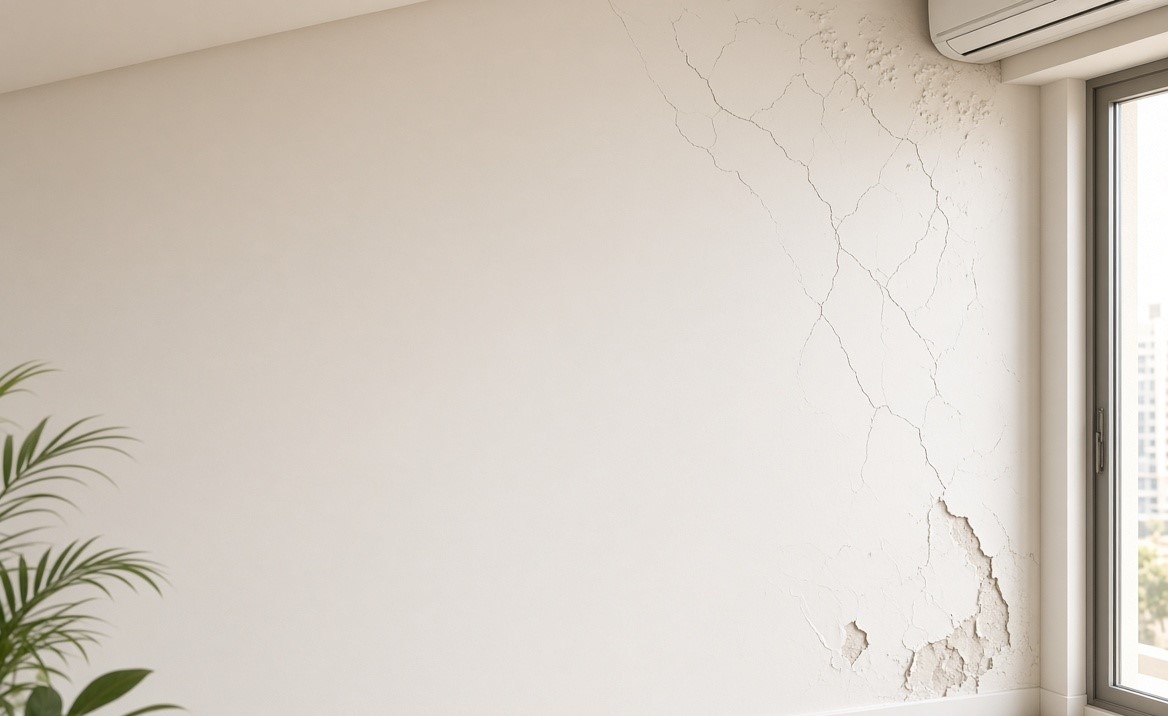
The walls were smooth. Now the cracks are back
The walls were skimmed and painted a few months ago and looked perfectly flat. Now fine hairline cracks are spreading across one wall, a patch near the AC unit has started to bubble, and a section by the window sounds hollow and flakes when you press it. Repainting hasn’t helped. The cracks show through again within weeks.
This is a common story with skim coat in UAE homes and buildings. It rarely means the material was bad. Usually, something about the wall underneath, the weather on the day, or the way it was applied stopped the skim coat from bonding and curing properly. Most of those causes can be checked.
What a skim coat is meant to do?
A skim coat is a thin layer of cement-based or polymer-modified compound spread over plaster, blockwork or concrete. Its job is to give a smooth, even base for paint and to hide minor surface marks. It is a finishing layer, not a structural one. It can bridge very fine surface marks, but it cannot hold together a wall that is moving or wet behind it.
When a skim coat in UAE conditions is applied to a sound, prepared wall and cured properly, it should stay smooth and bonded for years under normal paint maintenance.
Why skim coat fails in UAE conditions
1. The wall and the mix dried out too fast
Cement-based skim coats need water to cure. On a hot, dry wall, the substrate and the sun pull water out of the thin layer before it can gain strength. The result is a weak, powdery surface and a network of fine crazing cracks. This is the single most common reason a skim coat in UAE summers fails. Manufacturers such as Weber advise dampening the wall before application in hot weather and keeping the skim coat moist for two days afterwards.
2. Cracks underneath were skimmed over, not repaired
A skim coat is too thin to hold a moving crack. If a crack in the plaster, blockwork or concrete behind it is still active, it will reappear in exactly the same line. Product data sheets typically say to repair cracks and damaged areas before skimming.
3. It was applied too thick
Skim coats are made for thin layers, typically a few millimetres per pass. Using one thick coat to fill a badly uneven wall leads to shrinkage cracks and a weaker bond. Deep hollows need plaster or a repair mortar first.
4. Moisture behind the wall
Water from AC condensation, a leaking pipe, a roof or terrace, or rising damp at the base of a wall softens the skim coat and pushes paint off it as blisters. Polymer suppliers point out that moisture is the main weak spot of skim-coated walls, causing mould, cracks and blisters when exposure is constant.
5. Dust, old paint or a glossy surface underneath
If the wall was not cleaned, scraped and primed where needed, the skim coat bonds to dust or loose paint instead of the wall. That shows up as hollow-sounding patches and flaking.
6. Painting before it was dry
Paint applied over a skim coat that is still holding moisture traps that water. As the wall heats up, it tries to escape, causing bubbles and peeling.
Common fixes people try, and why they fall short
When a skim coat in UAE homes starts to crack or bubble, these are the usual first responses. Each one treats the surface rather than the cause.
| What people try | Why it often doesn’t solve it |
| Repainting over the cracks | Paint can’t bridge a crack that is still moving or a skim coat that is breaking down. The marks come back. |
| Adding another skim coat on top | If the first layer is weak or poorly bonded, the new layer sits on the same weak base. It can also make the total thickness too great. |
| Filling cracks with ordinary wall putty | Rigid putty works for static marks, but cracks caused by movement or water open again. |
| Treating bubbles without finding the water | The paint and skim coat are replaced, but the leak or condensation is still there, so blisters return. |
What you can check and do yourself?
These steps need no special product. They help whether you are repairing a failing wall or planning a new skim coat in UAE weather.
1. Find out if the crack is still moving
Draw a short pencil line across the crack at each end and note the date. Check it again after a few weeks. If the line has shifted, or the crack has grown, the cause is movement behind the skim coat. That needs repair to the wall itself before any finish goes back on. Cracks wider than a couple of millimetres, diagonal cracks from window corners, or cracks that keep growing are worth having a qualified engineer look at.
2. Track down any moisture first
Check AC drain lines and units near the damaged area, look for stains on the ceiling below terraces or bathrooms, and see whether damage is worst at the bottom of the wall. A simple moisture meter, or taping plastic sheet to the wall for a day and looking for condensation, will show whether the wall is wet. Fix the water source before re-skimming.
3. Tap test and scrape back to a sound surface
Tap the wall with a knuckle or screwdriver handle and mark hollow areas. Scrape and remove all loose or hollow skim coat and flaking paint until you reach a firm surface. Brush off dust. Patching over loose material only moves the problem a few centimetres.
4. Work with the heat, not against it
Skim in the early morning or evening, out of direct sun. Dampen the wall lightly before applying, keep each layer thin, and mist the finished surface with water for the curing period the data sheet recommends, which for some cement-based products is two days in hot weather. These simple steps make a large difference to how a skim coat in UAE summers holds up.
5. Let it dry fully before painting
Follow the drying time on the product data sheet, and allow longer in humid weather. Use a primer suitable for the surface before the topcoat. Rushing to paint is a common cause of bubbles within the first few weeks.
When a specialist does the job better?
If your checks show that the cracks are moving or the wall is wet, re-skimming alone won’t hold. The underlying problem needs fixing first, and that is where a repair and waterproofing specialist can help before the skim coat in UAE homes and buildings goes back on.
Petroline Technical Services lists crack injection and concrete repair among its services, for cracks in concrete that need to be repaired rather than covered.
Its listed services also include waterproofing and exterior coating. For external walls, it lists EIFS (exterior insulation and finish systems), which are designed for strong sun, heat and humidity. These address the water ingress and exposure that often cause a skim coat in UAE buildings to blister or crack.
Petroline is based in Al Ain and lists Abu Dhabi, Al Ain, Dubai and the wider UAE as its service area.
Who this is not right for?
A specialist isn’t needed for every wall. You probably don’t need one if:
- you have a few small, static hairline cracks in an indoor wall that you can scrape, re-skim and repaint yourself using the steps above;
- the issue is only cosmetic, such as uneven paint or minor marks, with no moisture and no movement;
- you only need a painter or plasterer for a routine refresh of a skim coat in UAE apartments;
- the wall shows signs of structural movement, such as wide diagonal cracks or doors and windows sticking. That needs a structural engineer’s assessment first.
FAQs
1. Why does a skim coat crack in the UAE?
Usually because it dried too fast in the heat, it was applied too thick, or it was put over a crack that is still moving. Dampening the wall, applying thin layers, curing with water and repairing cracks first prevent most cracking.
2. How long should a skim coat cure before painting?
Follow the product data sheet, as times vary by product and weather. Cement-based skim coats in hot weather are often kept moist for around two days, then left to dry fully before priming and painting. Allow more time in humid conditions.
3. Can a skim coat fix cracks in a wall?
Only very fine, static surface marks. A skim coat is a thin finishing layer, so active cracks in the plaster, blockwork or concrete behind it need to be repaired first or they will come back through.
4. Why is the paint bubbling on my skim-coated wall?
Bubbling usually means moisture: AC condensation, a leak, rising damp, or paint applied before the skim coat was dry. Find and fix the water source, remove loose material and let the wall dry fully before re-skimming and repainting.
5. Can skim coat be used on exterior walls in the UAE?
Some cement-based skim coats are made for both interior and exterior walls, so check the product data sheet. Exterior walls face strong sun, heat and humidity, so they also need proper crack repair, waterproofing where water gets in, and a suitable exterior paint or coating system.