
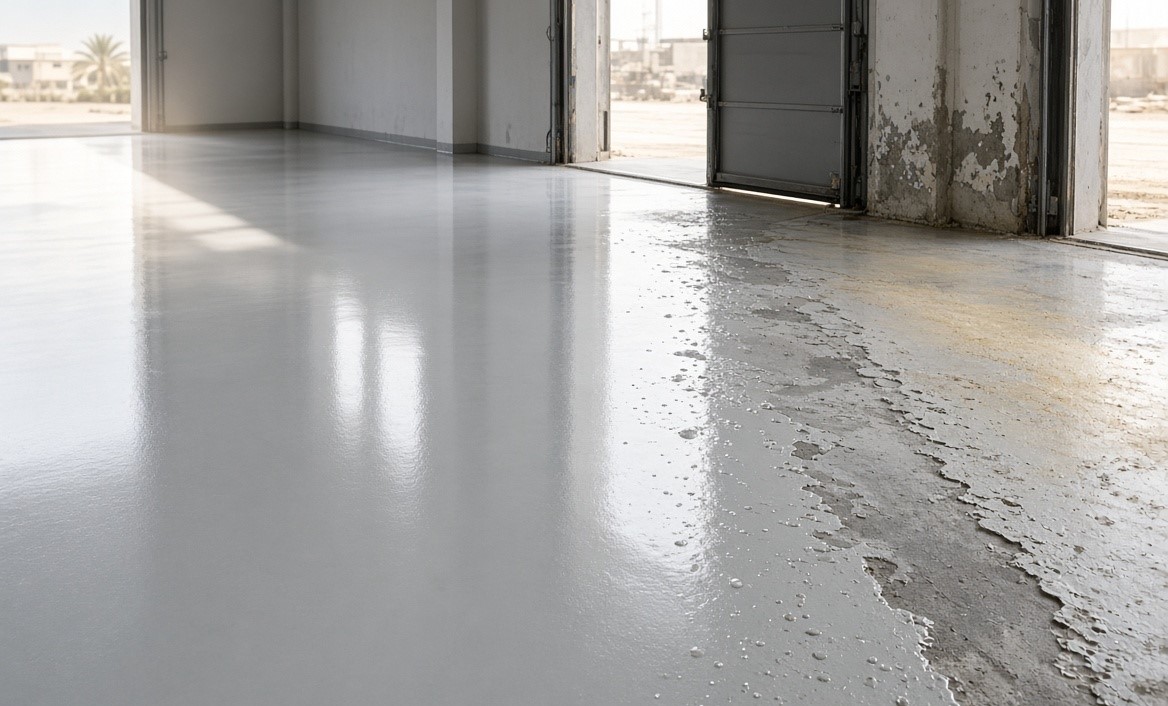
The floor looked great at handover. Now it doesn’t
A few months ago the new epoxy floor was smooth and glossy. Now there are small bubbles near the loading door, the coating is lifting at the edges of one bay, and the section by the outdoor entrance has turned a dull yellow. Forklift lanes are already showing grey concrete underneath.
If this sounds familiar, you’re not alone, and it doesn’t usually mean epoxy was the wrong choice. In most cases the coating failed because of something that happened before or during application, and most of those causes can be checked.
What a well-installed epoxy floor should do?
A properly specified and installed epoxy floor should bond firmly to the concrete, resist abrasion, oil and common chemicals, and be easy to clean. It should wear gradually in the busiest areas, not peel, blister or discolour within the first year. If yours is doing any of those things early, there is usually a specific cause behind it.
Why epoxy floors fail in UAE conditions?
1. Moisture rising through the slab
Concrete holds water long after it looks dry, and ground-level slabs can draw moisture up from below. When that moisture vapour pushes against a sealed epoxy layer, it forms blisters and bubbles, often in patches. New slabs and floors without a good vapour barrier are most at risk.
2. Poor surface preparation
Epoxy needs to bond to clean, sound, slightly rough concrete. If laitance (the weak powdery top layer), dust, oil, curing compound or old paint is left on the surface, the coating bonds to that layer instead. When the layer gives way, the epoxy peels off in sheets. This is the most common cause of edge lifting and delamination.
3. Applying it in high heat
Epoxy cures through a chemical reaction that speeds up as temperature rises. On a hot slab, or in a hot, unventilated space, the material can thicken too quickly to level out or release trapped air. The results are bubbles, roller marks and weaker bonding. Every product’s data sheet gives an application temperature range, and UAE summer conditions can easily go beyond it.
4. Standard epoxy used in direct sun
Most standard epoxies are not UV-stable. In direct sunlight, or under strong sun through glass, they yellow and can chalk over time. This is why outdoor areas and entrances often discolour first. Those areas usually need a UV-resistant topcoat, such as polyurethane or polyaspartic, over the epoxy.
5. A system that is too thin for the traffic
A thin roller-applied coating suits light foot traffic. Forklifts, pallet trucks, dragged loads and steel wheels need a thicker system, such as self-levelling epoxy or epoxy mortar. A floor specified mainly on price per square metre often ends up too thin for how it is actually used.
6. Cracks and joints coated over
Rigid epoxy cannot stretch. If moving cracks or construction joints are simply coated over, they will open again and crack through the new surface. Joints need a flexible sealant, and live cracks need to be assessed and repaired first.
Common fixes people try, and why they fall short
| What people try | Why it often doesn’t solve it |
| Recoating over the failed layer | New epoxy bonds to the old, poorly bonded coat, so it fails along with it. Loose material has to come off first. |
| Patching only the visible bubbles or peeling spots | If the cause is moisture or poor preparation, it usually affects a wider area. New failures keep appearing next to the patches. |
| Choosing the lowest price per square metre | Lower quotes often cut preparation or thickness, which are the two things that matter most for how long the floor lasts. |
| Using indoor epoxy outdoors | It will usually yellow and chalk in UAE sun unless it has a UV-resistant topcoat. |
What you can check and do yourself?
None of these needs a special product, and they apply whether you are planning a new floor or dealing with a failing one.
1. Test the slab for moisture before coating
Tape a square of clear plastic sheet (about 450 mm × 450 mm) tightly to the floor on all four sides and leave it for at least 16 hours. This is the simple plastic-sheet method in ASTM D4263. Condensation under the plastic, or darker concrete, means moisture is coming up. If you see that, ask your contractor how they will deal with it, for example with a moisture-tolerant primer, before any coating goes down.
2. Find loose and hollow areas early
Tap the floor with a hammer or screwdriver handle and listen for a hollow sound. Try lifting the coating at a blister or edge with a scraper. If it comes up easily and the back is clean or dusty, the problem is the bond, not wear. Mark those areas so they are removed rather than recoated.
3. Schedule work for the cooler part of the day
Ask for application in the early morning or evening, or in a shaded, air-conditioned space, and ask the applicator to check slab and air temperature against the product data sheet before starting. It costs nothing and removes one of the most common causes of bubbles.
4. Ask every contractor the same four questions
- How will you prepare the surface: grinding, shot-blasting or just cleaning?
- What total thickness will you apply, and is that right for our traffic?
- Which primer will you use, and how will you handle moisture?
- What topcoat will you use in areas that get direct sun?
Comparing answers, not just prices, shows you which quotes include the work that makes a floor last.
5. Look after the floor you have
Clean with a pH-neutral cleaner rather than harsh acids or solvents. Put mats at entrances to catch sand, which acts like sandpaper underfoot. Avoid parking vehicles straight off hot roads on a new floor, as hot tyres can mark or lift some coatings.
When a specialist applicator does the job better?
If the slab has a moisture problem, the floor carries forklift or heavy traffic, there are many cracks and joints to deal with, or the space needs an anti-static finish, it is usually easier to have one contractor handle the whole system rather than several trades.
Petroline Technical Services lists epoxy floor coating, ESD (anti-static) flooring, crack injection and concrete repair, and construction joint filling among its services. That means preparation, repair, joints and coating can be handled as one job.
Petroline is based in Al Ain and lists Abu Dhabi, Al Ain, Dubai and the wider UAE as its service area. Product technical data sheets are linked from the Datasheet section of its website, so you can check what is being specified.
Who this is not right for?
A specialist applicator isn’t the right choice for every floor. You may not need one if:
- you have a small home garage or storeroom with light traffic, where a good DIY kit and careful preparation may be enough;
- you are looking for the cheapest possible one-coat paint finish and don’t need a long-life system;
- you plan to cover the floor with tiles, vinyl or carpet, where a cementitious leveller is usually more suitable;
- the slab has structural damage, such as settlement or cracks that keep widening, which needs a structural engineer’s assessment before any coating.
FAQs
1. Why is my epoxy floor bubbling or blistering?
The most common causes are moisture vapour rising through the concrete slab and applying the coating when the slab or air is too hot. Both trap moisture or air under or inside the coating. A plastic-sheet moisture test before coating, and working in cooler hours, prevents most cases.
2. Why is my epoxy floor peeling?
Peeling usually means the coating never bonded properly to sound concrete, typically because laitance, dust, oil or old paint was not removed by grinding or shot-blasting. Loose areas need to be removed and the surface prepared again before recoating.
3. Can epoxy floor coating be used outdoors in the UAE?
Standard epoxy tends to yellow and chalk in direct sun. Outdoor and sun-exposed areas usually need a UV-resistant topcoat, such as polyurethane or polyaspartic, over the epoxy.
4. How much does epoxy floor coating cost in the UAE?
Published price guides vary widely. Basic coatings are often quoted from around AED 40–120 per square metre, while decorative, self-levelling and heavy-duty industrial systems commonly run from about AED 120 to over AED 400 per square metre. Surface preparation, thickness, site access and moisture treatment all affect the final price, so compare itemised quotes rather than headline rates.
5. What type of epoxy flooring is best for a warehouse with forklifts?
Thin roller coats tend to wear through quickly under forklift traffic. Warehouses usually need a thicker system, such as self-levelling epoxy or epoxy mortar, with joints sealed using a flexible sealant and a UV-stable topcoat wherever the floor gets direct sun.