
Most epoxy floors that fail in the UAE don’t fail because of the resin. They fail because the wrong system went onto the wrong slab, under the wrong conditions. A thin roller coat in a forklift aisle, a standard primer on damp concrete, or a glossy epoxy finish left in full sun will all look fine on handover day and disappoint within a year.
This guide is for facility managers, contractors, developers and property owners comparing options for epoxy floor coating in Dubai. It explains the main systems, which spaces each one suits, the local site conditions that decide how long a floor lasts, and what to check in a quote before you sign.
What an Epoxy Floor Coating Actually Is
An epoxy floor is a two-part resin (a base and a hardener) that cures into a hard, bonded layer on top of concrete. The term covers everything from a single coat of epoxy paint to a multi-layer system several millimetres thick, which is why quotes for “epoxy flooring” can vary so much.
A properly specified floor coating is a system, not a single product. It typically includes surface preparation, a primer that penetrates and seals the concrete, one or more body coats that provide thickness and wear resistance, and often a topcoat chosen for chemical, UV or slip resistance. When people compare one contractor’s price with another, they are often comparing different systems without realising it.
The Main Epoxy Floor Coating Systems Compared
The table below summarises the systems you are most likely to be offered for epoxy floor coating in Dubai. Thicknesses are typical ranges; the exact figures come from the manufacturer’s technical data sheet (TDS) for the specific product used.
| System | Typical thickness | Best suited to | Watch-outs |
| Roller-applied coating (primer + 2 coats) | Roughly 0.3–0.5 mm | Light-traffic stores, plant rooms, low-budget refreshes, dust-proofing | Wears through quickly under forklifts and pallet trucks |
| High-build / self-levelling epoxy | Roughly 1.5–3 mm | Warehouses, factories, labs, showrooms, hospital and commercial corridors | Needs a flat, well-prepared slab; longer installation than a roller coat |
| Epoxy mortar / screed | Typically 4 mm and above | Heavy impact, steel wheels, workshops, loading areas, uneven slabs | Higher cost; usually sealed with a further coat |
| Anti-slip (aggregate broadcast) | Varies with system | Ramps, wet process areas, kitchens, car park drive aisles | Rougher texture is harder to clean; grade the grit to the risk |
| Decorative (flake, metallic, quartz) | Varies with system | Showrooms, retail, villa garages, offices | Chosen for looks first; confirm it still meets the traffic load |
| ESD / anti-static epoxy | Varies with system | Electronics, data centres, explosive or flammable atmospheres | Must be tested for resistance values; a specialist system |
For most commercial and light-industrial projects, the real decision is between a roller coat and a self-levelling system. If the floor carries wheeled traffic every day, the extra thickness of a self-levelling or mortar system usually pays for itself in fewer repairs.
When Epoxy Is Not the Best Choice
Epoxy is versatile, but it has limits. Standard epoxies yellow and chalk under UV light, so they are a poor choice for open terraces and uncovered parking decks unless they are protected by a UV-stable topcoat. Areas exposed to thermal shock, such as commercial kitchens with hot-water washdowns, often perform better with polyurethane-based systems. Where downtime must be measured in hours rather than days, fast-curing polyurea or polyaspartic coatings may be worth considering. Our comparison of polyurethane coating vs epoxy coating in the UAE covers these trade-offs in more detail.
Matching the System to the Space
The fastest way to narrow down options for epoxy floor coating in Dubai is to start with how the space is used, not with a colour chart.
Warehouses and Logistics Centres
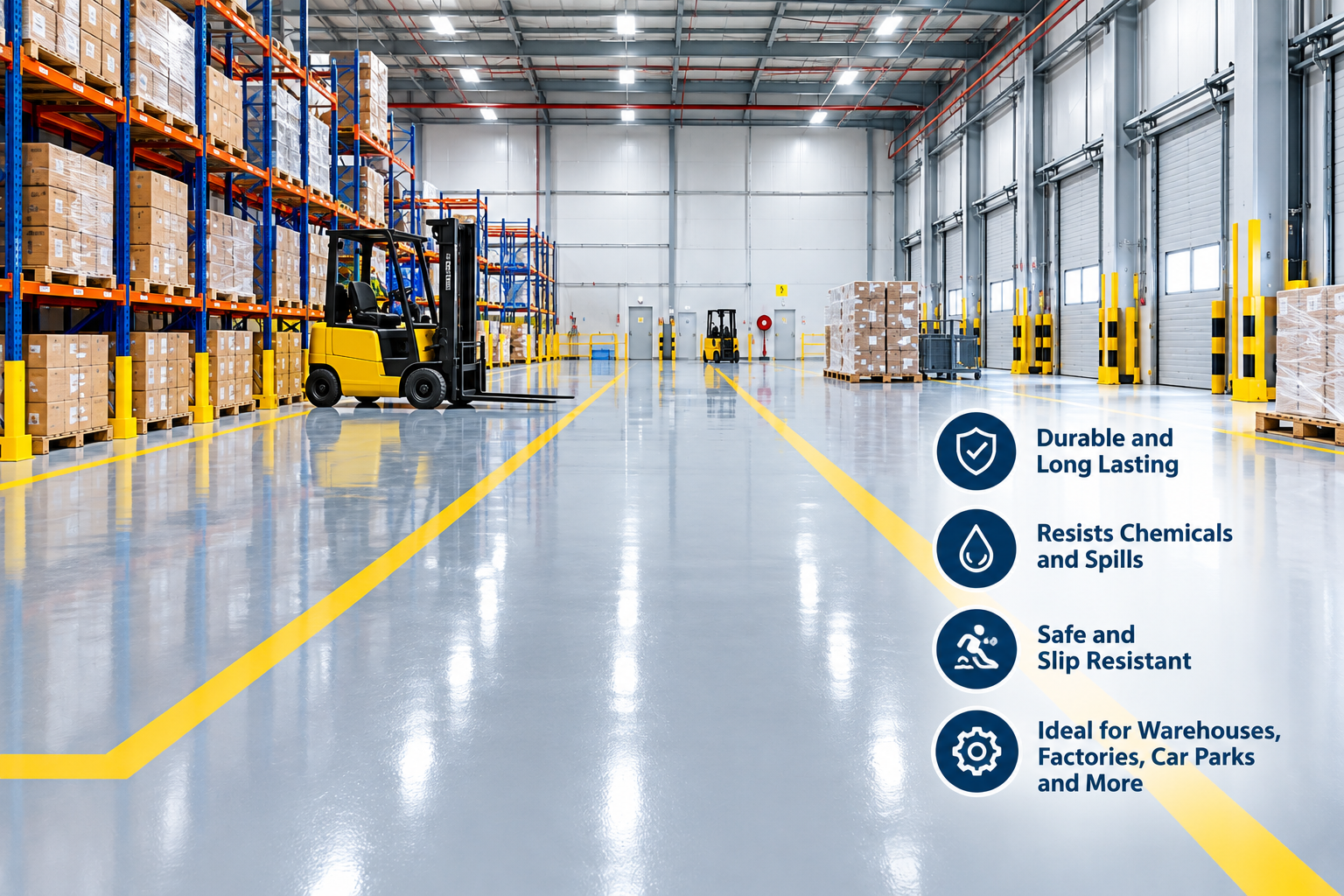
Forklift and pallet-truck traffic is the main stress, so warehouse projects for epoxy floor coating in Dubai are judged on durability first. A self-levelling or high-build system is the usual starting point, with joints treated so that wheels don’t chip the edges. Line marking for aisles and pedestrian routes can be built into the topcoat. We cover this in more detail in our guide to epoxy floor coating for warehouses in Dubai.
Factories, Workshops and Plant Rooms
Here, chemical spills, oils and dropped tools matter as much as traffic. Ask for the chemical resistance chart from the product’s data sheet and check it against the substances actually used on site. Epoxy mortar is worth considering in heavy engineering areas where impact is frequent.
Car Parks and Basements
Car parks are among the most common projects for epoxy floor coating in Dubai. Covered decks benefit from an anti-slip finish on ramps and drive aisles, and a smoother, easier-to-clean finish in parking bays. Basements bring an extra risk: moisture rising through the slab. Coating over an untreated wet slab is a common cause of blistering, so moisture testing and, where needed, waterproofing for underground parking should come first.
Food Processing and Commercial Kitchens
Hygiene, slip resistance and washdown temperatures drive the choice. Look for seamless coved skirtings at the wall junction so dirt can’t collect, and confirm whether the system is suitable for food environments. Where hot water or steam cleaning is routine, ask whether a polyurethane-based system would last longer than epoxy.
Showrooms, Offices, Villas and Garages
Appearance takes priority, but traffic still matters. A metallic or flake epoxy can look striking in a showroom, while a solid colour selected from the RAL colour chart keeps an office or villa garage clean and consistent. In garages, hot tyres can lift cheap epoxy paints, so a properly primed multi-coat system is the safer option.
Electronics and Sensitive Equipment Areas
Static discharge can damage components and, in some environments, ignite vapours. These areas need a dedicated ESD flooring solution with tested resistance values rather than a standard floor coating.
Dubai Site Conditions That Decide Whether a Floor Lasts
Climate and slab condition have more influence on the life of an epoxy floor coating in Dubai than the brand of resin. These are the factors a good contractor should raise before quoting.
Moisture in the Concrete Slab
On many projects for epoxy floor coating in Dubai, the slab itself is the weak point. Fresh concrete holds a lot of water. Most manufacturers ask for the slab to have cured for around 28 days and to be below a stated moisture limit before coating. Common checks include in-situ relative humidity probes (ASTM F2170) and the simpler plastic-sheet test (ASTM D4263). Ground-bearing slabs and basements can stay damp for much longer than expected, especially where there is no effective vapour barrier. Where moisture is high, a moisture-tolerant primer or a dedicated damp-proof epoxy primer can be used, but only if it is specified before work begins.
Heat and Humidity During Application
Summer is the most demanding season for epoxy floor coating in Dubai. Epoxy cures faster as temperatures rise, which shortens the time the applicators have to spread and level each mix. In the summer months, that can mean working early in the morning, at night or in air-conditioned conditions. Humidity matters too: manufacturers commonly require the substrate to be at least 3°C above the dew point during application. Ignoring this can cause a sticky, cloudy surface film known as amine blush, which weakens the bond of the next coat.
Sun and UV Exposure
Any area that sees direct sunlight, including through large showroom glazing, needs a UV-stable topcoat or a different system altogether. Without one, a white or light grey epoxy can turn noticeably yellow.
Dust and Sand
Fine dust settles on wet epoxy and becomes part of the finish. On active construction sites, the area should be closed off and cleaned before each coat, and the timing coordinated with other trades.
How a Professional Epoxy Floor Coating Is Installed
The steps below apply to most systems used for epoxy floor coating in Dubai. Skipping or rushing any of them is the most common reason a floor fails early.
- Site survey and testing. The contractor checks slab age, moisture, surface strength, levels, joints and contamination such as oil or old coatings.
- Repairs. Cracks, spalls and damaged joints are repaired first. Depending on the damage, this can involve crack injection, concrete repair or construction joint filling.
- Surface preparation. Diamond grinding or shot blasting removes laitance and opens the surface so the primer can bond. Acid etching is not a substitute on commercial floors. Our article on surface preparation to international standards explains why this step matters most.
- Priming. A primer suited to the slab’s moisture level seals the concrete and anchors the system.
- Body coats. Roller coats, self-levelling layers or mortar are applied to the specified thickness, with aggregate broadcast if anti-slip is required.
- Topcoat and markings. A sealer or UV-stable topcoat is applied where needed, along with line markings.
- Curing and handover. Light foot traffic is often possible after around 24 hours, while full chemical resistance commonly takes about seven days at moderate temperatures. The data sheet for each product gives the exact times.
What Affects the Cost of Epoxy Floor Coating in Dubai
Price guides published by Dubai contractors in 2026 show a wide spread, from well under AED 100 per square metre for thin roller coats to AED 400 or more for decorative finishes. That spread is mostly explained by a handful of factors:
- System and thickness. A 3 mm self-levelling floor uses several times the material of a two-coat roller system.
- Slab condition. Repairs, levelling, old coating removal and moisture treatment can add significantly to the scope.
- Area and access. Larger open areas are usually cheaper per square metre than small rooms, stairs or occupied buildings.
- Working hours. Night shifts, phased handovers and work around live operations take longer.
- Special requirements. Anti-slip grading, chemical resistance, ESD properties and coving all add cost.
For a longer view on spend versus lifespan, see our article on industrial coating cost vs durability.
How to Compare Quotes Fairly
Two quotes for epoxy coating in Dubai are only comparable if they describe the same work. Before choosing, ask each contractor to state:
- The product names and manufacturer, with data sheets attached
- The total dry film thickness, in millimetres or microns
- The surface preparation method (grinding or shot blasting)
- Whether moisture testing is included, and what happens if the slab fails
- How cracks and joints will be treated
- The curing time before foot traffic, vehicle traffic and chemical exposure
- Warranty terms, including what voids them
A quote that only lists “epoxy flooring, per m²” leaves too much open to interpretation.
Common Mistakes That Cause Epoxy Floors to Fail
Most early failures in epoxy floor coating in Dubai can be traced back to a short list of causes, and nearly all of them are preventable at the planning stage.
| Problem you see | Likely cause | How to prevent it |
| Peeling or flaking | Poor surface preparation, contamination, coating over laitance | Mechanical preparation and a clean, sound substrate |
| Blisters or bubbles | Moisture or vapour pushing up from the slab | Moisture testing; moisture-tolerant primer where needed |
| Sticky or cloudy surface | Amine blush from humidity or low substrate temperature | Respect the dew point rule; control the environment |
| Yellowing | UV exposure on a standard epoxy | UV-stable topcoat or an alternative system |
| Cracks reappearing through the coating | Untreated cracks or moving joints | Repair cracks and detail joints before coating |
| Wearing through in traffic lanes | System too thin for the load | Specify thickness to suit traffic |
Looking After an Epoxy Floor
Day-to-day care for an epoxy coating in Dubai is simple: sweep or vacuum grit, clean with a neutral cleaner, deal with spills promptly and use protective pads under heavy static loads. Avoid harsh solvent cleaners unless the data sheet confirms resistance. A worn topcoat can usually be refreshed before damage reaches the body coat, which is far cheaper than a full replacement. Our guide on how to maintain an epoxy coating in Dubai covers cleaning routines in more depth.
Working With Petroline Technical Services
Petroline Technical Services provides epoxy floor coating for car parks, warehouses, manufacturing plants, workshops, food processing facilities, foyers, heavy engineering plants and other industrial sites across the UAE, including Dubai. The company works with systems from established manufacturers such as Jotun, Sika, BASF, Fosroc and PAC Technologies, and also offers the preparation work a floor often needs first, from concrete repair and crack injection to joint filling.
Every project for epoxy floor coating in Dubai starts with a look at the slab and how the space is used, so the system is matched to the conditions rather than to a price list. You can see examples of past work on our projects page, or contact our team to arrange a site assessment.
FAQs
1. How much does epoxy floor coating in Dubai cost?
Cost depends mainly on the system, its thickness and the condition of the slab. Thin roller-applied coatings sit at the lower end, while self-levelling, mortar and decorative systems cost more. Repairs, moisture treatment and night work add to the scope. The most reliable figure comes from a site survey and a quote that lists products, thickness and preparation method.
2. How long does epoxy floor coating in Dubai take to install?
Most projects take a few days, depending on the area, the number of coats and the repairs needed. Each coat must cure before the next goes on. Light foot traffic is often possible after about 24 hours, but full chemical resistance usually takes around a week, according to the product data sheet.
3. How long does an epoxy floor last?
With proper maintenance, epoxy coatings can last anywhere from 5 to 10 years, depending on traffic and the environment. Thicker systems in correctly prepared slabs tend to sit at the upper end of that range, and refreshing a worn topcoat can extend it further.
4. Can epoxy be applied over tiles or an existing coating?
Sometimes. Tiles must be firmly bonded and mechanically abraded, and grout lines may show through thin coatings. An old coating must be sound and compatible with the new system, or it should be removed. A site test is the only way to confirm it.
5. Is epoxy suitable for outdoor areas in Dubai?
Standard epoxy is not ideal for areas in direct sun because it yellows and chalks under UV light. Outdoor areas usually need a UV-stable topcoat, such as an aliphatic polyurethane, or a different system such as polyurea.