
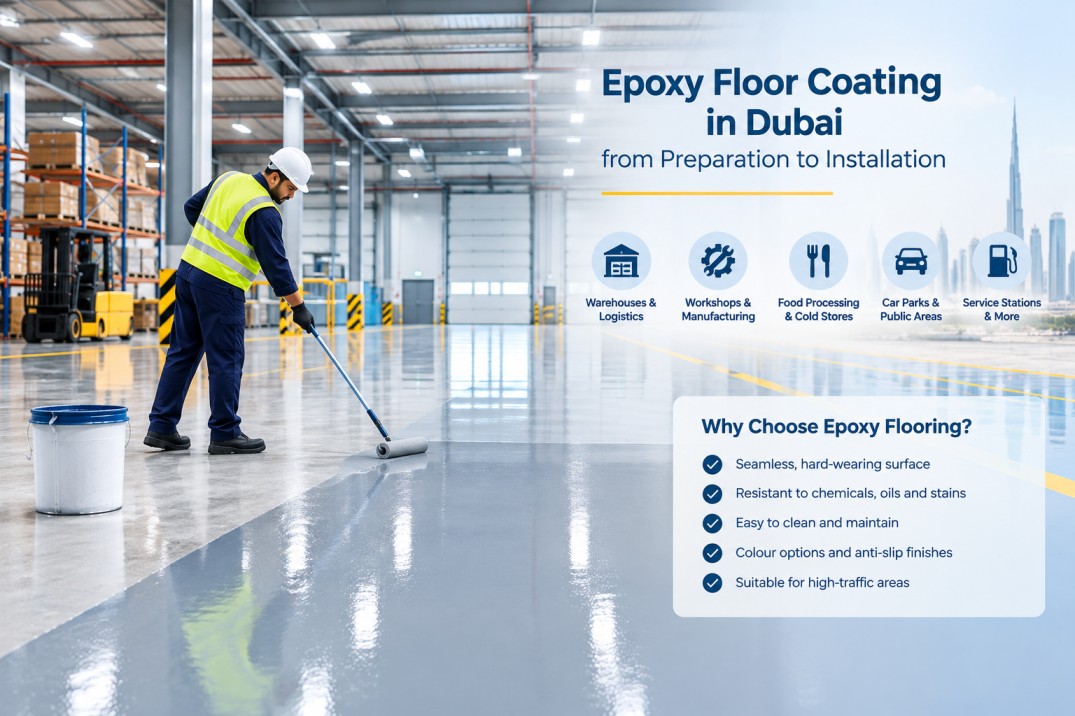
For warehouses, workshops, factories, service stations and other demanding facilities, the floor is a working surface not just a finishing detail. The right epoxy system can create a seamless, hard-wearing and easier-to-clean surface, but its performance depends on correct specification, substrate preparation and application.
Petrolinetech provides epoxy floor coating and related floor-coating solutions across the UAE, including Dubai. The most suitable system depends on the concrete condition, traffic, chemical exposure, slip risk, temperature, moisture and the time available for shutdown.
What epoxy coating does?
Epoxy coating is formed when a resin component reacts with a hardener. Once cured, it bonds to a properly prepared substrate and creates a protective surface. Depending on the specification, the finish may be smooth, textured, coloured, decorative or designed for higher slip resistance.
A coating is not a substitute for repairing a weak or damp floor. Cracks, contamination, laitance, rising moisture and movement must be assessed before the system is selected. This is why a site inspection is more useful than choosing a product from a price per square metre alone.
Where epoxy coating works best in Dubai?
Warehouses and logistics facilities
Forklifts, pallet movement, wheeled traffic and repeated loading can quickly expose weak concrete. A suitable epoxy floor system helps create a continuous surface that is easier to clean and maintain. Joint treatment, impact zones, turning areas and traffic routes should be considered during specification.
Workshops, service stations and manufacturing plants
Workshops and production areas may encounter oils, lubricants, chemicals, metal components and abrasive traffic. Epoxy can be selected for mechanical strength and chemical resistance, with textured finishes where spills could increase slip risk. Drainage, edges and areas around equipment also deserve attention.
Food processing, cold stores and technical rooms
Hygiene-sensitive areas benefit from seamless, non-porous finishes that reduce places where dirt and liquids can collect. The specification must still reflect cleaning chemicals, wash-down practices, temperature, impact and any regulatory or operational requirements. Cold-store work requires careful planning around substrate temperature and moisture.
Car parks, foyers and public areas
Epoxy can improve the appearance and cleanability of indoor car parks, foyers and concourses. For open or strongly sun-exposed areas, discuss UV-stable alternatives or a compatible polyurethane topcoat. A glossy surface should not be selected where glare or wet slip risk creates a safety concern.
Benefits and limitations
Benefits
- Strong adhesion when the substrate is correctly prepared.
- Resistance to many common oils, chemicals and stains; exact resistance depends on the formulation and exposure.
- Seamless finish that supports routine cleaning.
- Options for colour coding, line marking, decorative finishes and anti-slip texture.
- Suitability for high-traffic indoor commercial and industrial environments.
- Potentially reduced disruption when work is planned during shutdowns, weekends or holidays.
Limitations and when to consider polyurethane
Epoxy is not automatically the best coating for every surface. Standard epoxy may be vulnerable to prolonged direct UV exposure, and rigid systems may be unsuitable where the substrate moves significantly. Polyurethane is often considered for outdoor exposure, weathering and surfaces with greater movement, while hybrid systems can combine different performance characteristics. The final choice should follow a site-specific assessment rather than a generic product comparison. [web:3]
How the installation process works?
1. Site inspection and specification
The contractor should review the existing floor, intended use, traffic, contamination, moisture, temperature, drainage, expansion joints and required finish. Discuss operating hours and access at this stage so the programme reflects the real facility.
2. Surface preparation and repairs
Preparation may include cleaning, degreasing, mechanical grinding or shot blasting, dust removal and localised repairs. Weak concrete, laitance and contamination can prevent adhesion. Cracks and joints should be treated according to whether they are static, moving or structural.
3. Primer and coating application
A compatible primer may be used to improve adhesion and consolidate the prepared surface. The resin and hardener must be mixed in the manufacturer’s specified ratio, then applied within the product’s working time. Depending on the required build and service conditions, the system may include more than one coat.
4. Anti-slip and finish selection
Smooth finishes are easy to clean, while aggregate or textured finishes can improve traction in wet or oily locations. Colour, gloss, line marking and coving should be agreed before application. The best finish balances cleaning, safety, appearance and operating conditions.
5. Curing, inspection and handover
The floor must be protected from traffic while the coating cures. The time depends on the product, thickness, temperature, humidity and site conditions; the applicator should provide the permitted re-entry and full-service schedule. Handover should include cleaning guidance, restrictions and any recommended maintenance plan.
What affects project cost and duration?
A responsible quotation for epoxy coating in Dubai should account for more than floor area. Important variables include:
- Existing concrete condition and the extent of grinding or repair.
- Oil, chemical or other contamination requiring specialist cleaning.
- Moisture levels and whether additional mitigation is needed.
- Required coating thickness, number of layers and chemical exposure.
- Anti-slip aggregate, decorative finish, line marking, coving and edge details.
- Access, equipment movement, working hours and shutdown restrictions.
- Curing and re-entry requirements.
Ask the contractor to state what preparation is included, which areas are excluded, the proposed system, expected downtime, warranty terms and maintenance requirements. This makes quotations easier to compare and reduces the risk of an apparently low price becoming a higher final cost.
How to choose a coating contractor?
- Request a site assessment instead of relying on a standard package.
- Ask for the proposed system and the reason it suits the exposure.
- Confirm how moisture, contamination, cracks and joints will be handled.
- Check how the team will control dust, access and workplace safety.
- Ask for a written programme covering preparation, application, curing and handover.
- Confirm whether the contractor can schedule work around planned shutdowns.
Petrolinetech lists epoxy floor coating applications for car parks, manufacturing plants, workshops, service stations, dairies, food-processing units, warehouses, cold stores, heavy engineering facilities, substations, battery rooms, refineries, plating factories, helipads and marine decks. The service page also states that projects can be scheduled over weekends or holiday shutdowns with advance notice. [web:2]
Maintenance after installation
Keep the surface free from abrasive debris, clean spills promptly and use cleaning products compatible with the coating. Avoid dragging heavy equipment across the floor and repair localised damage before it spreads. Periodic inspections should focus on loading zones, turning points, joints, drains and areas exposed to chemicals.
Request an assessment from Petrolinetech
If you are planning epoxy coating in Dubai, share the floor area, location, current substrate, intended use, traffic, chemical exposure, photographs and preferred shutdown dates. Petrolinetech can use this information to assess the appropriate floor-coating approach and identify preparation requirements before issuing a quotation. The company’s published contact details include +971 3 722 00 95 and websales@petrolinetech.com. [web:2]
FAQs
1. What is epoxy coating used for?
It is used to protect and finish concrete and other suitable substrates in areas such as warehouses, workshops, factories, service stations, food-processing units, cold stores and car parks. The correct system depends on traffic, chemicals, moisture and the required safety finish.
2. Is epoxy suitable for outdoor areas in Dubai?
It can be suitable for some outdoor applications, but standard epoxy may not be the best choice where prolonged UV exposure, weathering or substrate movement is expected. Ask the contractor whether a UV-stable topcoat, polyurethane or another system is more appropriate.
3. How long does epoxy coating take to install?
The programme depends on area, repairs, preparation, coating build, access and curing conditions. A professional quotation should state preparation time, application stages and when light and full traffic can resume.
4. Can epoxy be applied over an existing concrete floor?
Often, yes, provided the substrate is sound, clean, sufficiently dry and properly prepared. Contamination, weak concrete, cracks and moisture can require treatment before coating.
5. Does epoxy flooring become slippery when wet?
A smooth coating can present a slip risk when contaminated with water or oil. Anti-slip aggregate and a suitable texture can be specified for areas where wet or oily conditions are expected.